Succeeding at your first pull-up
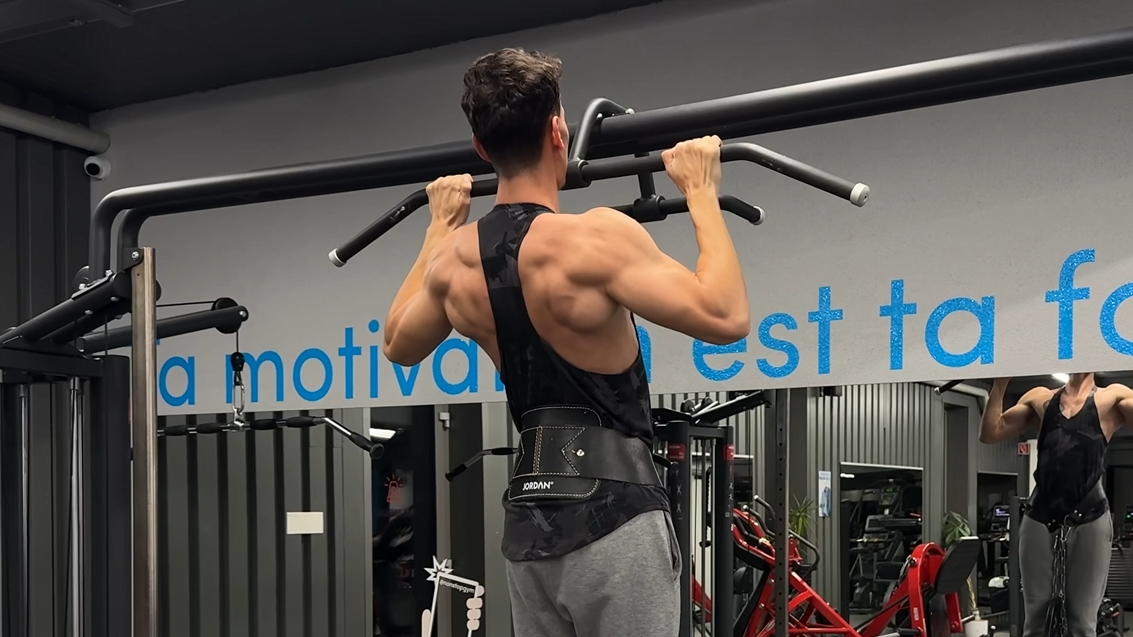
The first strict pull-up can seem out of reach when you're starting out. However, this movement doesn't rely solely on willpower or the number of attempts at the bar. It requires a clear progression, adapted technique, and strength built step by step. With targeted exercises, controlled range of motion, and consistency, achieving your first strict pull-up becomes a realistic goal.
Pull-up progression video
Why the strict pull-up requires a true progression
A strict pull-up involves pulling your body toward a bar without momentum, swinging, or excessive help from the legs. The movement heavily engages the latissimus dorsi, biceps, forearms, rear deltoids, and core stabilizer muscles.
Trying again and again may help you understand the movement, but it's rarely enough if pulling strength isn't there yet. The key is to gradually reduce assistance while improving control, grip, and scapular stability.
- Building a solid foundation with horizontal pulls
- Learning the full movement with reduced weight
- Developing control via slow descents
- Getting closer to a strict pull-up with less and less help
Foundation step with australian pull-ups
The australian pull-ups are often the best starting point for beginners. This exercise strengthens the back, biceps, rear deltoids, and scapular stability while remaining more accessible than a vertical pull-up.
Receive your personalized program
Stop training at random.
Get my programGet a program adapted to your goals, level, and available equipment. Reach your goals faster with a structured plan designed just for you.
- Program tailored to your profile
- Guided progression
- Compatible with your equipment
- Structured plan
Our coach prepares your program
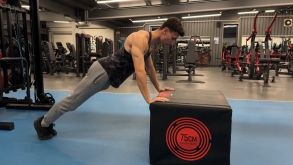
Get my programTo perform them, position yourself under a fixed bar or straps, heels on the ground, core engaged, and chest facing the bar. Pull by bringing your shoulder blades together, then lower yourself slowly without completely relaxing your shoulders. The more horizontal the body, the more difficult the exercise becomes.
This step teaches you to initiate the pull with your back rather than just your arms. Consequently, it prepares the body to better control its trajectory during future pull-ups.
Before trying to go higher, learn to pull cleaner.
Technical step with the assisted pull-up machine
The assisted machine pull-ups allow you to practice the full movement with reduced weight. It's an excellent tool for understanding the trajectory, working on range of motion, and repeating the movement without being immediately limited by your body weight.
The goal isn't to use maximum assistance to chain together easy repetitions. You should choose a weight that allows for clean reps, chin over the bar, and a controlled descent. Every repetition should look as much like a strict pull-up as possible.
- Keep your shoulders low and active during the pull
- Avoid pushing with your legs or bouncing off the support
- Reduce assistance only when your technique remains stable
In the app, you can find guided pull-up exercises in the free exercise and workout catalog, with instructions and demonstration videos. This is useful for checking your positioning and building more consistent upper-body sessions.
Strength step with negative pull-ups
The negative pull-ups involve starting at the top of the movement and then lowering yourself slowly until your arms are almost straight. This eccentric phase is very effective for developing the strength needed for strict pull-ups, as it allows you to control a high load even when the full upward pull isn't possible yet.
Get into position using a bench, a small jump, or a partner, then briefly hold the top position. Descend over three to five seconds, keeping your torso stable and your shoulder blades controlled. Quality is the priority, not quantity.
For example, three to five slow repetitions can be more useful than ten fast descents. If you lose control before the end, reduce the volume or temporarily return to assisted exercises.
Transition step with resistance band pull-ups
The resistance band pull-ups allow you to practice the full movement while gradually getting closer to a strict pull-up. The band generally helps most at the bottom of the movement, where many beginners lack the strength to start.
Start with a band strong enough to maintain a good range of motion. Then, switch to a lighter band as soon as you can perform several clean sets. The goal is to decrease help without sacrificing technique.
This step is ideal for learning to manage the coordination between grip, shoulder blades, back, and arms. It also creates an important psychological transition, as you are already training on a trajectory very close to the final pull-up.
How to organize this progression in your sessions
Effective progression must be consistent but recoverable. For most practitioners, two to three pull-up sessions per week are enough. Leave at least one rest day between two demanding sessions to maintain the quality of the movement.
You can integrate this progression into an upper-body session after the warm-up and before isolation exercises. This way, you work on pull-ups while your energy and coordination are still optimal.
- Total beginner: australian pull-ups then assisted machine
- Intermediate level: assisted machine then negative pull-ups
- Close to the first pull-up: light band then controlled strict pull-up attempts
- Coach or advanced practitioner: adjusting volume based on fatigue and technical quality
To speed up your progress without winging it, use the ready-to-use workout templates in the app or create your own session with the workout builder. You can configure reps, duration, rest times, supersets, and variations to adapt each block to your level.
Criteria that show you're ready
Before testing a strict pull-up, look for signs of mastery. You don't need to be perfect, but your body must be able to produce consistent force across the entire range of motion.
- You control several slow descents without a sudden drop
- You perform assisted pull-ups with a full range of motion
- Your grip remains solid until the end of the sets
- You manage to engage your shoulder blades before pulling with your arms
- You progress without pain in your shoulders, elbows, or wrists
Tracking is essential to know when to increase the difficulty. With personalized statistics, performance analysis, and adaptive recommendations from the app, you can identify your actual progress and adjust your sessions based on your goals, equipment, level, and targeted muscles.
Common mistakes to avoid
The biggest mistake is turning every session into a maximum strength test. Testing too often fatigues the nervous system, degrades technique, and slows down learning. A calmer but better-structured progression generally yields better results.
- Starting each repetition with shoulders completely relaxed
- Using leg momentum instead of a controlled pull
- Reducing the range of motion to do more repetitions
- Changing exercises every session without a progression logic
- Ignoring recovery, sleep, and joint pain
Patience and consistency remain essential. Even if progress seems slow, every well-executed repetition strengthens the muscles, coordination, and confidence needed to succeed.
Example of a pull-up-oriented upper-body session
Here is a simple structure to apply this method. Adjust the sets, reps, and rest according to your level, then gradually increase the difficulty as long as technique remains clean.
- Shoulder warm-up, wrist warm-up, and scapular activation for 5 to 8 minutes
- Australian pull-ups: 3 sets of 8 to 12 controlled repetitions
- Assisted machine pull-ups: 3 sets of 5 to 8 repetitions
- Negative pull-ups: 3 sets of 3 to 5 slow descents
- Band-assisted pull-ups: 2 to 4 sets of clean repetitions
- Core work or grip work based on your needs
To simplify implementation, discover this progression in the app, choose a ready-to-use template, or start building your session today. You can adapt every parameter and track your progress session after session.
Conclusion
Succeeding at your first strict pull-up requires a smarter method than simply repeating attempts. By combining australian pull-ups, machine assistance, negative descents, and bands, you build the necessary strength and control. Integrate this progression into your next upper-body session, move forward step by step, and let your consistency do the rest.
How long does it take to achieve your first strict pull-up starting from scratch?
Which exercises are most useful for preparing for a first strict pull-up?
Why do negative pull-ups help in achieving a strict pull-up?
Is it better to use an assisted machine or a band to learn pull-ups?
How many times a week should you train to progress in pull-ups?
How do I know if I'm ready to attempt my first strict pull-up?
Is it normal to progress slowly on pull-ups at first?
What is the most frequent mistake when trying to achieve your first pull-up?
Popular
Credits