Chest pump push-up workout
A structured push-up session can create a strong chest pump without any equipment at home or in the gym. This format is simple to follow, easy to scale, and effective for building upper-body endurance and control.
The exact chest pump workout
Use the exercises exactly in this order to keep the difficulty progressive. You start with an easier variation, build volume, then finish with more demanding push-up patterns that increase tension through the chest and triceps.
- 3 x 15 knee push-ups
- 4 x 12 incline push-ups
- 4 x 10 standard push-ups
- 3 x 10 diamond push-ups
- Rest 30 seconds between sets
- Rest 1 minute after the final set of each exercise
How the rest periods should work
Take 30 seconds of rest between sets inside the same exercise. After the last set of knee push-ups, incline push-ups, and standard push-ups, take 1 full minute before moving to the next exercise. As a result, you keep the pace high without losing too much rep quality.
Why this exercise order is effective
Receive your personalized program
Stop training at random.
Get my programGet a program adapted to your goals, level, and available equipment. Reach your goals faster with a structured plan designed just for you.
- Program tailored to your profile
- Guided progression
- Compatible with your equipment
- Structured plan
Our coach prepares your program
Get my programThis sequence works because it organizes the workout from the most accessible pattern to the most demanding finish. Knee push-ups help you establish rhythm and range of motion first. Incline push-ups then increase total chest volume, while standard push-ups raise the challenge. Diamond push-ups finish the session with a close-hand position that often feels especially intense through the inner chest and triceps.
How to perform each push-up correctly
Knee push-ups
Keep your shoulders over your hands and maintain a straight line from the knees through the hips to the head. Lower under control and press back up without letting the hips collapse. This variation reduces the load while teaching solid push-up mechanics.
Incline push-ups
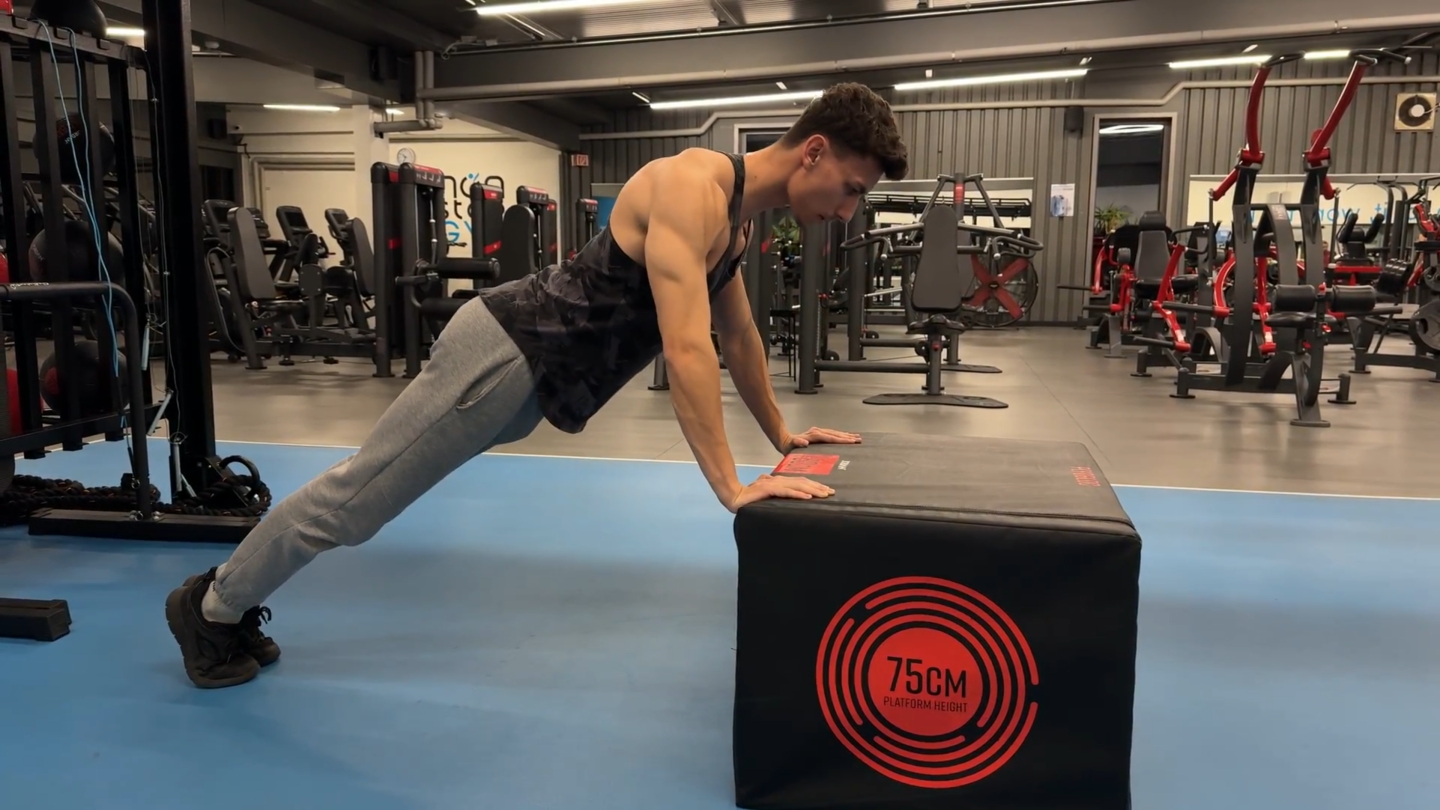
Place your hands on a stable bench box or sturdy surface. The higher the surface, the easier the set becomes. For example, this is a useful option at home on a countertop or in the gym on a bench when you want smooth reps and a longer chest-focused set.
Standard push-ups
Set your hands around shoulder width and brace your core before each rep. Lower until your chest is close to the floor, then press up while keeping the body rigid. This is your main strength benchmark in the workout.
Diamond push-ups
Bring the hands closer together under the chest so the thumbs and index fingers form a diamond shape or a narrow hand position. Keep the elbows controlled and avoid rushing the bottom phase. Because this variation is demanding, strict form matters more than speed.
Form cues for a better chest pump
- Brace your core before every set to protect body alignment.
- Lower with control instead of dropping into the bottom position.
- Press the floor away and finish each rep with intent.
- Stop the set if your hips sag or your range becomes too short.
- Keep each rep smooth so the chest stays under constant tension.
A stronger chest pump usually comes from cleaner reps shorter rest and better exercise order rather than from sloppy speed.
How to use this workout at home or in the gym
At home, use a wall table or countertop for incline push-ups if needed. In the gym, a flat bench or box works well for the same setup. Because the workout needs no equipment beyond an optional elevated surface, it fits busy schedules, small spaces, and fast upper-body sessions.
How to make the session easier or harder
If the workout feels too hard, raise the incline or reduce the tempo so you can keep proper form. If it feels too easy, slow the lowering phase and pause briefly near the bottom.
- Choose a higher surface for incline push-ups to reduce difficulty.
- Slow each rep to increase time under tension.
- Add one extra round only after all prescribed sets look clean.
- Focus on full range of motion before chasing faster reps.
Make this workout easier to follow and repeat
This is exactly the kind of session that becomes more useful when it is saved and tracked. With the app you can explore a free public exercise and workout catalog with guided instructions and demonstration videos, which helps you check each movement quickly and train with more confidence.
- Start fast with ready-to-use workout templates.
- Recreate this push-up session in the custom workout builder.
- Configure reps duration rest time supersets and more for full control.
- Track your sessions with personalized stats performance insights and adaptive recommendations.
- Get a training experience customized to your goals equipment fitness level and target muscles.
Common mistakes to avoid
- Rushing reps and cutting range of motion too early.
- Taking longer than planned rest periods and losing workout density.
- Letting the hips drop during standard or diamond push-ups.
- Using an unstable surface for incline push-ups.
- Adding difficulty before mastering the prescribed format.
This chest pump workout is simple, structured, and effective for both home and gym training without equipment. For even better consistency, save the routine in the app, track your performance, and adjust the setup as your strength and endurance improve.
Is this chest pump push-up workout good for beginners at home?
How long does this no-equipment chest pump workout usually take?
Can I do this chest workout in the gym even without using machines?
What should I do if I cannot complete all the standard or diamond push-up reps?
Why are the rest periods so short in this push-up chest pump session?
How many times per week can I do this bodyweight chest pump workout?
What is the best way to track progress with a push-up workout like this?
Popular
Credits