Full-body muscular endurance
11 Exercises
Intro
Required equipment
No equipment
Muscles
Standard
Warm-up

Perform controlled circles in both directions without shrugging your shoulders. Reduce the range of motion if discomfort occurs. Read more Read less
Perform controlled circles in both directions without shrugging your shoulders. Reduce the range of motion if discomfort occurs.
30 seconds - 40 seconds
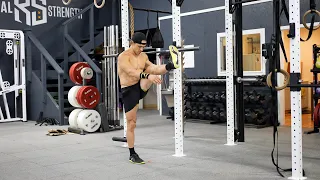
Alternate legs with a progressively increasing, controlled range of motion. Use a stable support if needed.
30 seconds - 40 seconds
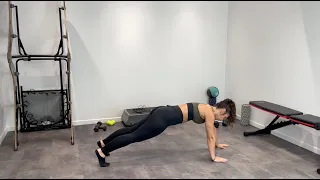
Walk your hands forward into a plank position, then return. Bend your knees slightly if needed.
5 - 7 Repetitions
Circuit
4 rounds
Main
Do each exercise one after another. When you finish the list, rest then start again.

Keep your knees aligned with your feet and use a controlled range of motion. Progress toward the upper end of the range, then make the movement slightly more demanding with a slower descent or a pause at the bottom. Read more Read less
Keep your knees aligned with your feet and use a controlled range of motion. Progress toward the upper end of the range, then make the movement slightly more demanding with a slower descent or a pause at the bottom.
Round
1: 15 - 25 Repetitions
Round
2: 15 - 25 Repetitions
Round
3: 15 - 25 Repetitions
Round
4: 15 - 25 Repetitions
Chain without rest
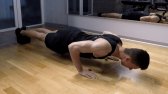
Keep your core braced and your elbows angled slightly backward. Use the Knee Push-Up if needed. Once you can perform the upper end of the range with good control, use a slower tempo or pause at the bottom. Read more Read less
Keep your core braced and your elbows angled slightly backward. Use the Knee Push-Up if needed. Once you can perform the upper end of the range with good control, use a slower tempo or pause at the bottom.
Round
1: 8 - 15 Repetitions
Round
2: 8 - 15 Repetitions
Round
3: 8 - 15 Repetitions
Round
4: 8 - 15 Repetitions
Chain without rest
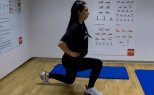
Perform the prescribed range on each leg with a stable front foot. Reduce the range of motion if needed. A pause at the bottom can increase difficulty. Progress from the lower to the upper end of the repetition range. Once you have mastered the upper end of the range for two exposures, use a slightly more difficult tempo, range of motion, or variation, then return to the lower end of the range. If repeated failure occurs, return to the lower end of the range or use the indicated regression. Read more Read less
Perform the prescribed range on each leg with a stable front foot. Reduce the range of motion if needed. A pause at the bottom can increase difficulty. Progress from the lower to the upper end of the repetition range. Once you have mastered the upper end of the range for two exposures, use a slightly more difficult tempo, range of motion, or variation, then return to the lower end of the range. If repeated failure occurs, return to the lower end of the range or use the indicated regression.
Round
1: 10 - 16 Repetitions
Round
2: 10 - 16 Repetitions
Round
3: 10 - 16 Repetitions
Round
4: 10 - 16 Repetitions
Chain without rest
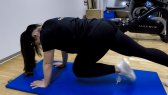
Maintain a steady pace without trying to sprint. Progress toward the upper end of the duration range only if your pelvis remains stable and your breathing stays controlled. Progression is limited to duration or a better-controlled variation, without turning the exercise into a maximal effort. Read more Read less
Maintain a steady pace without trying to sprint. Progress toward the upper end of the duration range only if your pelvis remains stable and your breathing stays controlled. Progression is limited to duration or a better-controlled variation, without turning the exercise into a maximal effort.
Round
1: 35 seconds - 55 seconds
Rest time : 1 minute
Round
2: 35 seconds - 55 seconds
Rest time : 1 minute
Round
3: 35 seconds - 55 seconds
Rest time : 1 minute
Round
4: 35 seconds - 55 seconds
Rest time : 1 minute
1 minute rest between each round
Repeat 4 times
1 minute rest
Superset
Main
Do each exercise back to back without resting between them. Rest after completing the pair.
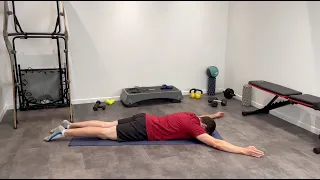
Raise your arms diagonally without arching your lower back. Keep the movement slow and add a brief pause at the top once you have mastered the upper end of the range. Read more Read less
Raise your arms diagonally without arching your lower back. Keep the movement slow and add a brief pause at the top once you have mastered the upper end of the range.
Set
1: 12 - 18 Repetitions
Set
2: 12 - 18 Repetitions
Chain without rest
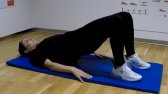
Finish each repetition with hip extension without hyperextending your lower back. Increase difficulty with a longer pause at the top. Progress from the lower to the upper end of the repetition range. Once you have mastered the upper end of the range for two exposures, use a slightly more difficult tempo, range of motion, or variation, then return to the lower end of the range. If repeated failure occurs, return to the lower end of the range or use the indicated regression. Read more Read less
Finish each repetition with hip extension without hyperextending your lower back. Increase difficulty with a longer pause at the top. Progress from the lower to the upper end of the repetition range. Once you have mastered the upper end of the range for two exposures, use a slightly more difficult tempo, range of motion, or variation, then return to the lower end of the range. If repeated failure occurs, return to the lower end of the range or use the indicated regression.
Set
1: 15 - 25 Repetitions
Set
2: 15 - 25 Repetitions
Rest time : 1 minute
Standard
Cool-down

Keep your pelvis neutral and your knees close together. Use a support if needed.
25 seconds - 35 seconds
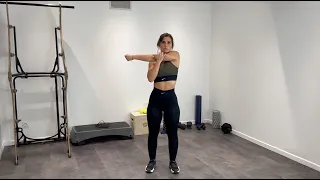
Gently bring your arm across your chest without shrugging your shoulder. Hold only a comfortable stretch.
25 seconds - 35 seconds
This workout is part of a complete program.
View program