Seated Leg Twist
Demonstration video

Recommended by our experts
Receive your personalized program
Stop training at random.
Get my program- Program tailored to your profile
- Guided progression
- Compatible with your equipment
- Structured plan
Our coach prepares your program
Get my programHow to do Seated Leg Twist
Instructions
- Sit on the floor with your knees bent and feet together.
- Place your hands behind your hips for support and lean your torso slightly back.
- Brace your core and keep your chest lifted.
- Rotate both knees to one side while keeping control through your trunk.
- Return to the center, then rotate both knees to the opposite side.
- Continue alternating sides with a smooth and controlled rhythm.
Technical tips
- Keep your spine long instead of rounding your lower back.
- Move from your hips and core, not by swinging your legs.
- Keep your shoulders relaxed and away from your ears.
- Control the return to center on every repetition.
- Reduce the range of motion if your lower back or hips feel uncomfortable.
Breathing tips
- Inhale as you return your knees to the center.
- Exhale as you rotate your knees to the side.
- Keep breathing steady and avoid holding your breath.
- Use each exhale to maintain abdominal tension.
Medical restrictions
- Avoid this exercise if you have acute lower back pain.
- Avoid this exercise if spinal rotation aggravates your symptoms.
- Use caution if you have hip impingement or painful hip mobility restrictions.
- Stop if you feel sharp pain, numbness, or radiating discomfort.
- Consult a healthcare professional if you are recovering from abdominal, hip, or spine surgery.
Description
The Seated Leg Twist is a simple floor-based core exercise designed to improve rotational control, trunk coordination, and body awareness without any equipment. It is especially useful for beginners because the hands remain on the floor for support, making the movement easier to control than more demanding twisting exercises. By moving the legs from side to side while maintaining a stable seated position, this exercise helps train controlled rotation and teaches you to resist excessive momentum.
This movement is often used in fitness, Pilates-inspired core routines, warm-ups, and general bodyweight training because it is accessible, low impact, and easy to modify. The range of motion can be shortened for comfort or increased gradually as control improves. It can also help prepare the body for more dynamic core exercises that involve rotation, anti-rotation, or coordinated lower-body movement.
The Seated Leg Twist is a practical choice for home workouts, beginner core circuits, mobility-focused sessions, and low-equipment training plans. It encourages smooth movement, controlled transitions, and stable posture, making it a valuable exercise for building better movement quality. When performed slowly and deliberately, it can improve coordination and help reinforce proper core engagement during rotational patterns.
Frequently asked questions
-
What are the benefits of doing Seated Leg Twists?
Seated Leg Twists help improve core control, rotational coordination, and trunk stability using only bodyweight. They are beginner-friendly and easy to include in home workouts. -
What muscles do I work with Seated Leg Twists?
Seated Leg Twists mainly target the abs, with strong involvement from the obliques and supporting muscles around the lower back and hips. -
What is the most common mistake in Seated Leg Twists?
The most common mistake is swinging the legs too fast and losing core tension. Move slowly, keep your chest lifted, and control each side-to-side rotation. -
Are Seated Leg Twists safe for my lower back?
Seated Leg Twists are generally safe when performed with control and a comfortable range of motion. Avoid forcing rotation if you have lower back pain or spinal sensitivity. -
How are Seated Leg Twists different from Russian Twists?
Seated Leg Twists emphasize rotating the legs while the hands support the body, making them easier and more stable. Russian Twists usually involve rotating the torso and are often more demanding. -
How many Seated Leg Twists should I do?
Start with 10 to 20 controlled repetitions per side or 30 to 45 seconds. Focus on smooth movement quality before increasing speed or volume.
Variants and alternatives
See all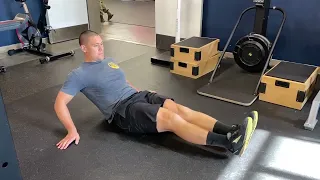
Related fitness articles
See all
Body recomposition: lose fat while building muscle
Muscle gain

Fitness formulas: protein, water, creatine and caffeine
Muscle gain

Carb cycling: useful for losing weight and performing better?
Nutrition

Muscle failure in strength training: what the science says
Muscle gain

Peptides in bodybuilding: effectiveness and risks
Nutrition
Chest pump push-up workout
Muscle gain
Succeeding at your first pull-up
At the gym

Shoulder pain in weight training: prevention and solutions
Risk of injuries
Recommended by our experts
Receive your personalized program
Stop training at random.
Get my program- Program tailored to your profile
- Guided progression
- Compatible with your equipment
- Structured plan
Our coach prepares your program
Get my program