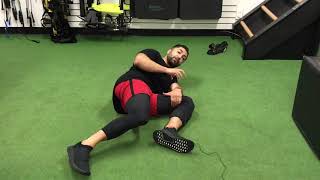
Side-Lying Quad Stretch
Demonstration video
Recommended by our experts
Receive your personalized program
Stop training at random.
Get my program- Program tailored to your profile
- Guided progression
- Compatible with your equipment
- Structured plan
Our coach prepares your program
Get my programHow to do Side-Lying Quad Stretch
Instructions
- Lie on one side with your head supported and your bottom leg slightly bent.
- Stack your shoulders and hips, then bend your top knee.
- Reach back with your top hand and hold your ankle.
- Gently tuck your pelvis and guide your heel toward your buttocks.
- Move the top thigh slightly backward until you feel a comfortable stretch.
- Hold the position without bouncing, then release slowly and switch sides.
Technical tips
- Keep your hips stacked instead of rolling backward.
- Keep your knees close together throughout the stretch.
- Maintain a neutral lower back and avoid arching.
- Pull gently and stop before the stretch becomes painful.
- Hold your ankle rather than pulling forcefully on your toes.
Breathing tips
- Inhale slowly while setting up the position.
- Exhale as you gently deepen the stretch.
- Continue breathing slowly and evenly throughout the hold.
- Use each exhalation to relax without forcing additional range.
Medical restrictions
- Acute knee pain, swelling, or a recent knee injury
- Recent knee or hip surgery without medical clearance
- Painful or severely limited knee flexion
Description
The Side-Lying Quadriceps Stretch is a simple lower-body flexibility exercise designed to reduce feelings of stiffness and support comfortable movement at the hip and knee. Its supported position makes it useful after training, during a recovery routine, or as part of a gentle flexibility session. Because the body rests on the floor, many people find it easier to relax than during standing stretches that also require balance.
Regular practice can help maintain the range of motion needed for walking, running, squatting, climbing stairs, cycling, and other activities that repeatedly bend and straighten the knee. It may also improve comfort after long periods of sitting or workouts involving a high volume of leg exercises. By encouraging relaxation, the stretch can contribute to smoother movement quality and greater awareness of differences between sides.
The exercise is easy to include in home, gym, or sports routines. It can serve as a brief recovery activity, complement other lower-body flexibility exercises, or form part of a cooldown that helps the body transition away from intense activity. Consistent, moderate stretching is generally more beneficial than occasional aggressive sessions, making this exercise well suited to regular practice.
The Side-Lying Quadriceps Stretch does not build maximal strength or replace a complete mobility program. However, it offers an accessible way to support flexibility, recovery, and everyday movement comfort. Its stable position also allows users to concentrate on relaxation and control without being distracted by balance demands.
Frequently asked questions
-
What are the benefits of doing the Side-Lying Quadriceps Stretch?
The Side-Lying Quadriceps Stretch can improve front-thigh flexibility, support comfortable hip and knee movement, reduce post-workout stiffness, and help maintain range of motion for everyday and athletic activities. -
What is the most common mistake I should avoid during the Side-Lying Quadriceps Stretch?
The most common mistake is arching the lower back and allowing the top hip to roll backward. Keep your pelvis gently tucked, your hips stacked, and your knees close together. -
Is the Side-Lying Quadriceps Stretch safe for my knees?
It is generally safe when performed gently and without pain. Reduce the amount of knee flexion if you feel excessive pressure, and stop if you experience sharp pain, swelling, or joint discomfort. -
How long should I hold the Side-Lying Quadriceps Stretch?
Hold the stretch for 20 to 30 seconds per side and repeat one to three times. Longer holds may be used during dedicated flexibility sessions if the position remains comfortable. -
Where should I feel the Side-Lying Quadriceps Stretch?
You should feel a gentle stretch along the front of the upper thigh and possibly near the front of the hip. You should not feel sharp pain or strong pressure inside the knee.
Variants and alternatives
See all
Related fitness articles
See all
Body recomposition: lose fat while building muscle
Muscle gain

Fitness formulas: protein, water, creatine and caffeine
Muscle gain

Carb cycling: useful for losing weight and performing better?
Nutrition

Muscle failure in strength training: what the science says
Muscle gain

Peptides in bodybuilding: effectiveness and risks
Nutrition
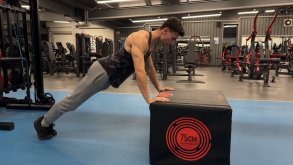
Chest pump push-up workout
Muscle gain
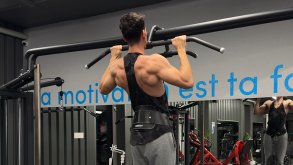
Succeeding at your first pull-up
At the gym

Shoulder pain in weight training: prevention and solutions
Risk of injuries
Recommended by our experts
Receive your personalized program
Stop training at random.
Get my program- Program tailored to your profile
- Guided progression
- Compatible with your equipment
- Structured plan
Our coach prepares your program
Get my program