Wall Posture Hold
Demonstration video
Recommended by our experts
Receive your personalized program
Stop training at random.
Get my program- Program tailored to your profile
- Guided progression
- Compatible with your equipment
- Structured plan
Our coach prepares your program
Get my programHow to do Wall Posture Hold
Instructions
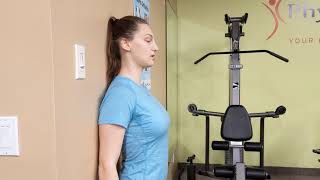
- Stand with your back against a wall and place your feet slightly forward.
- Keep your weight evenly distributed between both feet.
- Bring your pelvis and upper back gently toward the wall.
- Position your head naturally without forcing it backward.
- Let your arms rest beside your body with your shoulders relaxed.
- Maintain a tall, neutral posture for the prescribed duration.
Technical tips
- Keep your chin level rather than lifting or excessively tucking it.
- Avoid flattening your lower back forcefully against the wall.
- Keep your ribs controlled without holding your breath.
- Stop the hold if you feel sharp pain, dizziness, or numbness.
Breathing tips
- Inhale slowly through your nose while maintaining your alignment.
- Exhale gently without allowing your ribs or pelvis to shift.
- Continue breathing normally throughout the entire hold.
Medical restrictions
- Acute neck pain aggravated by upright posture
- Recent shoulder or spinal injury
- Severe lower-back pain aggravated by standing
- Persistent dizziness or balance problems without supervision
Description
The Wall Posture Hold is a simple isometric exercise designed to improve postural awareness, standing alignment, and control of the body in an upright position. By using a wall as an external reference, the exercise helps you recognize how your head, torso, and pelvis are positioned relative to one another. This immediate feedback makes it especially useful for people who spend long periods sitting, working at a desk, or looking down at electronic devices.
Regular practice can help reinforce a more balanced standing position and improve awareness of habits such as rounding forward, lifting the shoulders, pushing the head forward, or excessively arching the lower back. The exercise is low impact, requires no specialized equipment, and can be performed at home, in the gym, or during a short workplace movement break.
The Wall Posture Hold is also a practical introductory drill for beginners who need to develop control before progressing to more dynamic posture exercises. Because the position is maintained rather than repeated, attention can remain focused on alignment, controlled breathing, and even weight distribution. This makes the movement suitable for warm-ups, corrective routines, active recovery sessions, and general fitness programs.
Consistent practice may make it easier to recognize and correct poor positioning during daily activities and other exercises. The goal is not to force every part of the body against the wall, but to establish a comfortable, sustainable, and well-organized standing posture.
Frequently asked questions
-
What are the benefits of doing the Wall Posture Hold?
The Wall Posture Hold improves postural awareness, standing alignment, body control, and the ability to recognize common habits such as forward-head posture or excessive lower-back arching. -
What is the most common mistake during the Wall Posture Hold?
The most common mistake is forcing the head or lower back firmly against the wall. Maintain a comfortable neutral position instead of trying to eliminate every natural spinal curve. -
Is the Wall Posture Hold safe for my neck and back?
It is generally a low-impact exercise when performed comfortably. Stop if the position causes sharp pain, numbness, dizziness, or worsening neck or back symptoms. -
How long should I hold the Wall Posture Hold?
Beginners can start with 20 to 30 seconds and gradually progress toward 45 to 60 seconds while maintaining relaxed breathing and consistent alignment.
Related fitness articles
See all
Body recomposition: lose fat while building muscle
Muscle gain

Fitness formulas: protein, water, creatine and caffeine
Muscle gain

Carb cycling: useful for losing weight and performing better?
Nutrition

Muscle failure in strength training: what the science says
Muscle gain

Peptides in bodybuilding: effectiveness and risks
Nutrition
Chest pump push-up workout
Muscle gain
Succeeding at your first pull-up
At the gym

Shoulder pain in weight training: prevention and solutions
Risk of injuries
Recommended by our experts
Receive your personalized program
Stop training at random.
Get my program- Program tailored to your profile
- Guided progression
- Compatible with your equipment
- Structured plan
Our coach prepares your program
Get my program