Seated Scapular Retraction
Demonstration video

Recommended by our experts
Receive your personalized program
Stop training at random.
Get my program- Program tailored to your profile
- Guided progression
- Compatible with your equipment
- Structured plan
Our coach prepares your program
Get my programHow to do Seated Scapular Retraction
Instructions
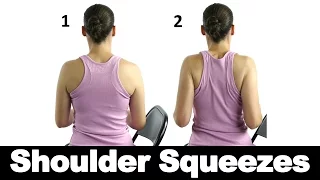
- Sit upright with your feet flat on the floor and your arms relaxed by your sides.
- Keep your head neutral and gently draw your shoulder blades backward toward each other.
- Pause briefly without lifting your shoulders.
- Slowly release the shoulder blades to the starting position and repeat.
Technical tips
- Keep your ribs stacked over your pelvis and avoid arching your lower back.
- Move from the shoulder blades rather than pulling the elbows behind you.
- Keep the shoulders down and away from the ears.
- Use a controlled range without forcing the shoulder blades together.
Breathing tips
- Exhale as you draw the shoulder blades together.
- Inhale as you slowly return to the starting position.
- Maintain calm, continuous breathing throughout the set.
Medical restrictions
- Acute shoulder pain or recent shoulder surgery
- Acute neck pain that increases during the movement
- Recent upper-back injury without medical clearance
Description
Sitting Scapular Retraction is a simple posture-focused exercise that teaches controlled movement of the shoulder blades while the torso remains stable. It is especially useful for people who spend long periods sitting, working at a computer, or using a phone, because these habits often encourage a rounded upper-body position and reduced awareness of shoulder-blade motion. By practicing a deliberate backward glide of the shoulder blades, the exercise can improve postural control, upper-body alignment, and the ability to maintain a more open chest position during daily activities.
This movement is also valuable as a preparation drill before resistance training. Better shoulder-blade control can support more efficient mechanics during rows, pull-downs, pressing movements, and many overhead exercises. Because it requires no equipment and can be performed from a chair, it is easy to include in office breaks, beginner routines, rehabilitation-oriented sessions, or warm-up sequences.
The seated position reduces balance demands and allows the user to focus on precision rather than effort. The main objective is not to squeeze as hard as possible, but to develop smooth, repeatable control without compensating through the neck or lower back. Regular practice may help improve body awareness, reduce the tendency to hold the shoulders forward, and reinforce a more stable foundation for upper-body movement. It is best performed slowly, with a brief pause at the end of each repetition and a relaxed return to the starting position.
Frequently asked questions
-
What are the benefits of Sitting Scapular Retraction?
It improves shoulder-blade control, postural awareness, and upper-body positioning, making it useful for desk workers, beginners, and warm-ups before pulling or pressing exercises. -
What is the most common mistake in Sitting Scapular Retraction?
The most common mistake is shrugging the shoulders or arching the lower back instead of moving the shoulder blades backward in a controlled manner. -
Is Sitting Scapular Retraction safe for my shoulders and neck?
It is generally safe when performed gently and without pain. Stop if it causes sharp shoulder pain, increasing neck pain, numbness, or tingling. -
What muscles does Sitting Scapular Retraction work?
It primarily targets the upper-back muscles responsible for scapular retraction, especially the rhomboids and middle trapezius, with assistance from the rear deltoids. -
How many repetitions of Sitting Scapular Retraction should I do?
A practical starting point is 8 to 15 controlled repetitions for 2 to 3 sets, focusing on smooth movement and a brief pause rather than maximum effort.
Variants and alternatives
See all
Related fitness articles
See all
Body recomposition: lose fat while building muscle
Muscle gain

Fitness formulas: protein, water, creatine and caffeine
Muscle gain

Carb cycling: useful for losing weight and performing better?
Nutrition

Muscle failure in strength training: what the science says
Muscle gain

Peptides in bodybuilding: effectiveness and risks
Nutrition
Chest pump push-up workout
Muscle gain
Succeeding at your first pull-up
At the gym

Shoulder pain in weight training: prevention and solutions
Risk of injuries
Recommended by our experts
Receive your personalized program
Stop training at random.
Get my program- Program tailored to your profile
- Guided progression
- Compatible with your equipment
- Structured plan
Our coach prepares your program
Get my program