Demonstration video
Receive your personalized program
Stop training at random.
Get my programGet a program adapted to your goals, level, and available equipment. Reach your goals faster with a structured plan designed just for you.
- Program tailored to your profile
- Guided progression
- Compatible with your equipment
- Structured plan
Our coach prepares your program
Get my programHow to do the lying hamstring stretch
Instructions
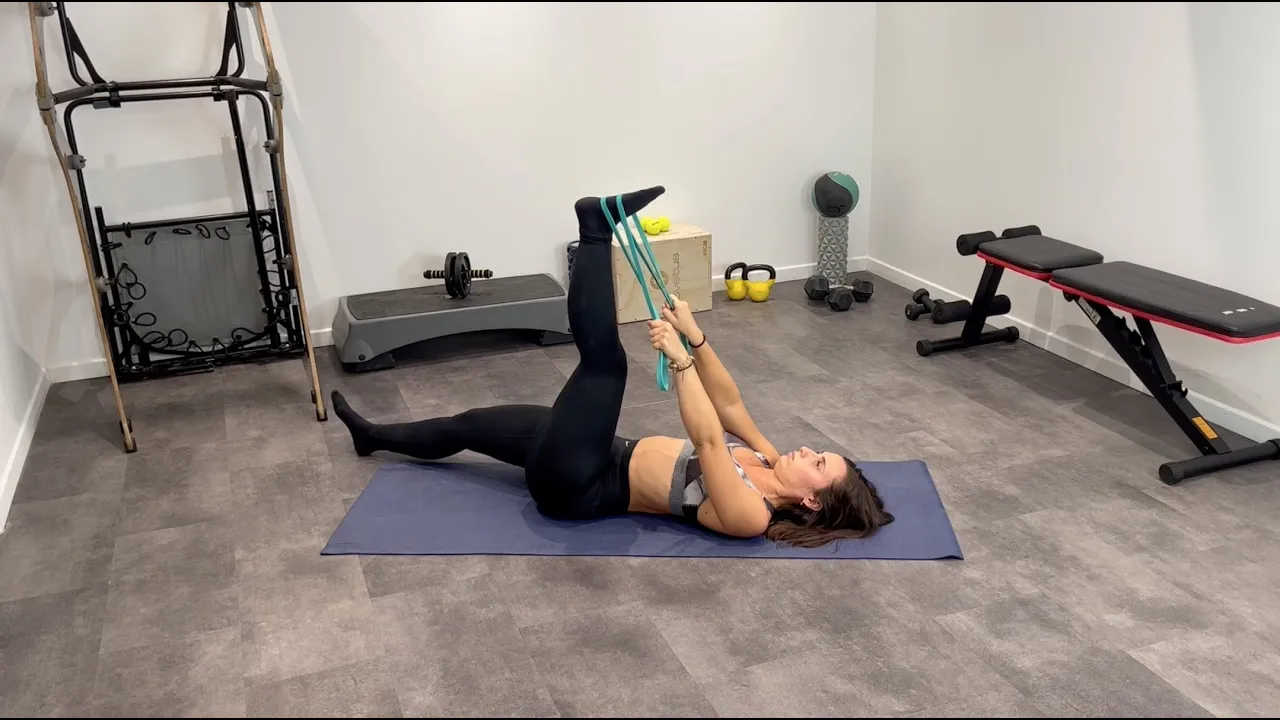
- Lie flat on your back on a mat with both legs extended.
- Lift one leg upward while keeping the other leg straight on the floor.
- Hold the back of your thigh or calf with both hands.
- Gently pull the raised leg toward your chest until you feel a stretch.
- Keep your hips and lower back pressed into the floor.
- Hold the position, then slowly lower the leg and switch sides.
Technical tips
- Keep the raised leg as straight as possible without locking the knee.
- Avoid lifting your hips or rounding your lower back.
- Move slowly and avoid bouncing during the stretch.
- Engage your core lightly to stabilize your pelvis.
Breathing tips
- Inhale before lifting your leg.
- Exhale as you gently pull your leg closer to deepen the stretch.
- Maintain slow, steady breathing while holding the position.
Medical restrictions
- Hamstring tears or acute strain
- Lower back injury or herniated disc
- Sciatic nerve pain or severe sciatica
- Recent hip surgery
Description
The Supine Hamstring Stretch is a fundamental flexibility exercise designed to improve posterior chain mobility and reduce muscle tightness. Performed lying on your back, this stretch allows controlled and gradual lengthening of the hamstrings while minimizing strain on the lower back. It is widely used in fitness, yoga, and rehabilitation settings due to its accessibility and effectiveness.
This stretch is particularly beneficial for individuals who spend long periods sitting, as prolonged sitting often leads to shortened and stiff hamstrings. By regularly incorporating the supine hamstring stretch into your routine, you can enhance overall movement quality, improve posture, and support better performance in both daily activities and athletic movements.
Additionally, this exercise promotes relaxation and recovery by encouraging blood flow and reducing muscular tension. It is commonly used during warm-ups, cooldowns, or dedicated mobility sessions. Because it is performed on the floor, it provides a stable and safe environment, making it suitable for beginners and individuals recovering from minor physical limitations.
The Supine Hamstring Stretch is also highly adaptable, allowing variations in intensity depending on flexibility levels. Whether used for general fitness, injury prevention, or recovery, it remains one of the most effective and widely recommended stretches for maintaining healthy and functional lower-body mobility.
Read more
Read less
Description
The Supine Hamstring Stretch is a fundamental flexibility exercise designed to improve posterior chain mobility and reduce muscle tightness. Performed lying on your back, this stretch allows controlled and gradual lengthening of the hamstrings while minimizing strain on the lower back. It is widely used in fitness, yoga, and rehabilitation settings due to its accessibility and effectiveness. This stretch is particularly beneficial for individuals who spend long periods sitting, as prolonged sitting often leads to shortened and stiff hamstrings. By regularly incorporating the supine hamstring stretch into your routine, you can enhance overall movement quality, improve posture, and support better performance in both daily activities and athletic movements. Additionally, this exercise promotes relaxation and recovery by encouraging blood flow and reducing muscular tension. It is commonly used during warm-ups, cooldowns, or dedicated mobility sessions. Because it is performed on the floor, it provides a stable and safe environment, making it suitable for beginners and individuals recovering from minor physical limitations. The Supine Hamstring Stretch is also highly adaptable, allowing variations in intensity depending on flexibility levels. Whether used for general fitness, injury prevention, or recovery, it remains one of the most effective and widely recommended stretches for maintaining healthy and functional lower-body mobility.
Read more Read lessFAQ