Lying Rope Cable Pullover
Demonstration video

Recommended by our experts
Receive your personalized program
Stop training at random.
Get my program- Program tailored to your profile
- Guided progression
- Compatible with your equipment
- Structured plan
Our coach prepares your program
Get my programHow to do Lying Rope Cable Pullover
Instructions
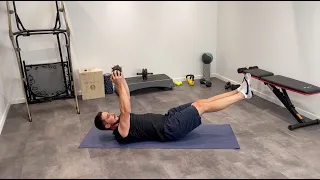
- Attach a rope to a low cable pulley and position a flat bench in line with the cable.
- Hold the rope with a neutral grip and lie face up with your head near the pulley.
- Plant your feet firmly and extend your arms behind your head with a slight bend in your elbows.
- Brace your torso and pull the rope forward in a wide arc without changing your elbow angle.
- Finish with your hands near your hips and briefly squeeze at the bottom.
- Slowly return your arms overhead until you feel a controlled stretch, then repeat.
Technical tips
- Keep your ribs down and avoid arching your lower back.
- Maintain a small, fixed bend in your elbows throughout the repetition.
- Move through the shoulders rather than turning the exercise into a triceps extension.
- Keep your shoulders away from your ears and your neck relaxed.
- Use a controlled load that allows a smooth, pain-free range of motion.
Breathing tips
- Inhale as you slowly return the rope overhead.
- Exhale as you pull the rope toward your hips.
- Maintain gentle abdominal pressure throughout the repetition.
Medical restrictions
- Acute shoulder pain or shoulder impingement symptoms.
- Recent rotator cuff or labral injury without medical clearance.
- Severe lower-back pain aggravated by overhead arm positions.
- Recent chest, shoulder, or upper-back surgery.
Description
The bench lying rope cable pullover is a controlled upper-body pulling exercise designed to build strength and muscular development through a long, sweeping arm path. Performing the movement from a supported position reduces the need to balance the torso, making it easier to concentrate on a smooth contraction and consistent range of motion. The rope attachment also allows the hands to separate slightly near the end of the pull, which can create a natural finishing position and improve comfort compared with a fixed handle.
A key advantage of this exercise is its continuous resistance. Tension remains present from the stretched position through the shortened position, helping develop control at both ends of the movement. This makes the exercise useful for hypertrophy-focused training, accessory work, and improving awareness of shoulder-extension mechanics. It can also complement rows and pulldowns by challenging the upper body without relying heavily on elbow flexion.
Because the body is supported on a bench, the exercise is well suited to deliberate tempos, moderate loads, and higher-quality repetitions. It is generally most effective when performed with a load that allows a full, controlled arc rather than maximal weight. The movement can be placed near the middle or end of an upper-body session, where it works well as a focused finishing exercise. Consistent execution may improve pulling efficiency, reinforce controlled overhead positioning, and add training volume without the systemic fatigue associated with heavier multi-joint lifts.
Frequently asked questions
-
What benefits will I get from the bench lying rope cable pullover?
It provides continuous resistance, supports controlled shoulder extension, improves mind-muscle connection, and adds focused hypertrophy volume with limited elbow involvement. -
What is the most common mistake I should avoid during a lying rope cable pullover?
The most common mistake is bending and straightening the elbows. Keep a fixed, slight elbow bend so the movement comes primarily from the shoulders. -
Is the bench lying rope cable pullover safe for my shoulders and lower back?
It is generally safe when performed with a pain-free range, moderate resistance, stable shoulders, and a braced torso. Stop if you feel sharp shoulder or back pain. -
How does the lying rope cable pullover compare with the standing cable pullover?
The lying version provides more torso support and reduces balance demands, while the standing version requires greater core stabilization and may offer easier setup. -
How many sets and reps should I perform?
For muscle development, perform 2 to 4 sets of 8 to 15 controlled repetitions with a load that does not compromise your range or elbow position. -
What muscles do I work with a lying rope cable pullover?
The exercise primarily targets the back, especially the lats, while the serratus anterior, long head of the triceps, and abdominal muscles assist or stabilize the movement.
Variants and alternatives
See all






Related fitness articles
See all
Body recomposition: lose fat while building muscle
Muscle gain

Fitness formulas: protein, water, creatine and caffeine
Muscle gain

Carb cycling: useful for losing weight and performing better?
Nutrition

Muscle failure in strength training: what the science says
Muscle gain

Peptides in bodybuilding: effectiveness and risks
Nutrition

Chest pump push-up workout
Muscle gain

Succeeding at your first pull-up
At the gym

Shoulder pain in weight training: prevention and solutions
Risk of injuries
Recommended by our experts
Receive your personalized program
Stop training at random.
Get my program- Program tailored to your profile
- Guided progression
- Compatible with your equipment
- Structured plan
Our coach prepares your program
Get my program