Doorway Row
Demonstration video

Recommended by our experts
Receive your personalized program
Stop training at random.
Get my program- Program tailored to your profile
- Guided progression
- Compatible with your equipment
- Structured plan
Our coach prepares your program
Get my programHow to do Doorway Row
Instructions
- Stand facing an open, sturdy doorway and grip both sides of the frame at about chest height.
- Walk your feet forward and lean your body back while keeping your body straight.
- Pull your chest toward the doorway by driving your elbows backward.
- Pause briefly when your chest reaches the doorway.
- Lower yourself under control until your arms are fully extended.
- Repeat for the desired number of repetitions.
Technical tips
- Keep your body in a straight line from head to heels.
- Lead the movement by pulling your elbows behind your body.
- Avoid shrugging your shoulders toward your ears.
- Squeeze your shoulder blades together at the top.
- Control the lowering phase without dropping quickly.
Breathing tips
- Inhale while lowering into the starting position.
- Exhale as you pull yourself toward the doorway.
- Maintain steady breathing throughout each repetition.
Medical restrictions
- Recent shoulder injury or surgery.
- Acute elbow or wrist injury.
- Severe lower back pain that worsens during pulling.
- Avoid if the doorway or frame is unstable or damaged.
Description
The Doorway Row is an accessible bodyweight pulling exercise that helps develop upper-body strength using nothing more than a sturdy doorway. It is an excellent choice for beginners learning horizontal pulling mechanics, as well as for experienced exercisers looking for a convenient home workout without equipment. By adjusting your body angle, you can easily increase or decrease the difficulty, making it suitable for a wide range of fitness levels. This movement promotes balanced upper-body development by introducing an effective pulling pattern that complements pressing exercises often performed in home workouts. It can improve posture, increase pulling endurance, and enhance body control during everyday activities that require lifting or pulling. Because it relies entirely on body weight, the Doorway Row is a practical solution for people training while traveling or exercising in limited spaces. The exercise also encourages controlled movement, coordination, and awareness of proper body positioning, making it valuable for building foundational movement quality before progressing to more advanced rowing variations. Whether included in a full-body routine, a calisthenics workout, or a general fitness program, the Doorway Row provides an efficient and scalable way to strengthen the upper body with minimal setup. Consistent practice can improve overall pulling performance and help create a more balanced training program without requiring access to a gym.
Frequently asked questions
-
What are the benefits of doing Doorway Rows?
Doorway Rows improve pulling strength, posture, body control, and upper-body endurance while requiring no equipment, making them ideal for home workouts. -
What is the most common mistake when doing Doorway Rows?
The most common mistake is rounding the shoulders or bending the hips. Keep your body straight and pull with controlled movement instead of using momentum. -
Are Doorway Rows safe for my shoulders?
Yes, Doorway Rows are generally shoulder-friendly when performed with good technique and a sturdy doorway. Stop if you experience pain or instability. -
How do Doorway Rows compare with Inverted Rows?
Doorway Rows are easier to set up and usually less demanding, making them ideal for beginners, while Inverted Rows allow greater loading and progression. -
How can I make Doorway Rows harder?
Move your feet farther forward to increase your body angle, slow the lowering phase, pause at the top, or perform higher repetitions with strict form.
Variants and alternatives
See all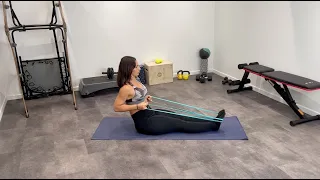
Seated banded rows
Beginner
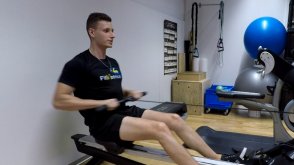
Rowing machine
Beginner
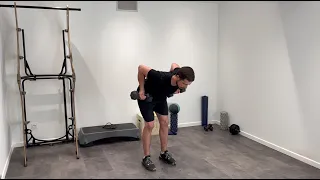
Dumbbell supination row
Intermediate
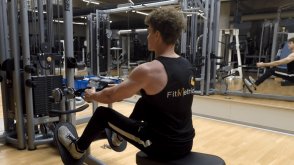
Close grip seated cable row
Beginner
Single kettlebell supinated row
Intermediate
Two-handed kettlebell rear delt row
Beginner
Bent over dumbbell row
Intermediate

Single-arm machine row
Beginner
Smith machine bent-over row
Intermediate
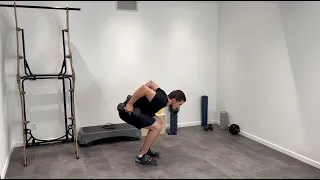
Dumbbell pendlay row
Intermediate
Upright barbell row
Intermediate
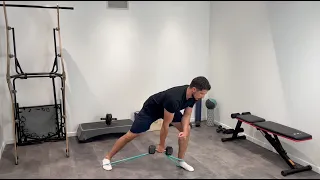
Banded chainsaw dumbbell row
Intermediate
Related fitness articles
See all
Body recomposition: lose fat while building muscle
Muscle gain

Fitness formulas: protein, water, creatine and caffeine
Muscle gain

Carb cycling: useful for losing weight and performing better?
Nutrition

Muscle failure in strength training: what the science says
Muscle gain

Peptides in bodybuilding: effectiveness and risks
Nutrition
Chest pump push-up workout
Muscle gain
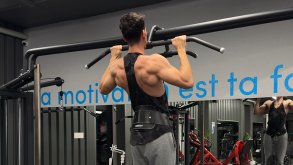
Succeeding at your first pull-up
At the gym

Shoulder pain in weight training: prevention and solutions
Risk of injuries
Recommended by our experts
Receive your personalized program
Stop training at random.
Get my program- Program tailored to your profile
- Guided progression
- Compatible with your equipment
- Structured plan
Our coach prepares your program
Get my program