Bicycle Crunch
Demonstration video

Recommended by our experts
Receive your personalized program
Stop training at random.
Get my program- Program tailored to your profile
- Guided progression
- Compatible with your equipment
- Structured plan
Our coach prepares your program
Get my programHow to do Bicycle Crunch
Instructions
- Lie on your back with your hands lightly behind your head and your legs raised.
- Lift your shoulder blades from the floor and draw one knee toward your chest.
- Rotate your torso so the opposite elbow moves toward the bent knee.
- Extend the other leg without letting it touch the floor.
- Switch sides smoothly and continue alternating with control.
Technical tips
- Keep your lower back gently pressed toward the floor.
- Rotate through your torso instead of pulling your elbow across.
- Keep your elbows open and avoid pulling on your neck.
- Move slowly enough to maintain control through every repetition.
- Extend the straight leg only as low as you can without arching your back.
Breathing tips
- Exhale as you rotate and bring the elbow toward the opposite knee.
- Inhale briefly as you pass through the center.
- Maintain a steady breathing rhythm instead of holding your breath.
Medical restrictions
- Acute lower-back pain or a recent spinal injury
- Symptomatic neck pain or a recent cervical injury
- Abdominal surgery without medical clearance
- Uncontrolled abdominal hernia
- Pregnancy when supine exercise is not medically recommended
Description
The bicycle crunch is a dynamic floor exercise that combines trunk flexion, rotation, and alternating leg movement in one continuous pattern. It is widely used in fitness programs because it develops controlled movement through the midsection while also challenging coordination between the upper and lower body.
Unlike a basic crunch, the bicycle crunch adds a cross-body action. This makes the exercise useful for improving rotational strength, trunk endurance, pelvic control, and overall movement efficiency. The alternating rhythm also creates a greater coordination demand, which can support better body awareness during sports, running, lifting, and everyday activities that require the torso to resist or produce rotation.
The exercise can be adjusted easily by changing the tempo, range of motion, or length of each set. Slower repetitions increase control and make it easier to maintain consistent tension, while longer sets place more emphasis on muscular endurance. Because the movement is performed in a continuous alternating pattern, it can also raise the training intensity without requiring heavy external resistance.
The bicycle crunch is most effective when quality remains higher than speed. Controlled repetitions help reduce momentum and make each side contribute evenly. It can be included in core-focused sessions, full-body workouts, circuit training, or short conditioning blocks. For best results, it should complement other trunk exercises that emphasize anti-extension, anti-rotation, and stable breathing under tension.
Frequently asked questions
-
What are the benefits of bicycle crunches?
Bicycle crunches build trunk endurance, rotational control, coordination, and the ability to stabilize the pelvis while the arms and legs move. -
What is the most common mistake in bicycle crunches?
The most common mistake is rushing and pulling the head forward. Slow down, keep the elbows open, and create the rotation through the torso. -
Are bicycle crunches safe for my lower back?
They can be safe when performed with a controlled range and a stable lower back. Stop if you feel sharp pain, excessive arching, or discomfort that increases with each repetition. -
How many bicycle crunches should I do?
Start with 2 to 3 sets of 8 to 15 controlled repetitions per side. Increase repetitions only when you can maintain consistent form. -
Is a slow bicycle crunch better than a fast one?
A slower tempo usually improves control, range, and tension, while faster repetitions often reduce precision and encourage momentum.
Variants and alternatives
See all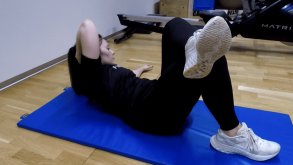
Lateral abdominal crunch
Beginner
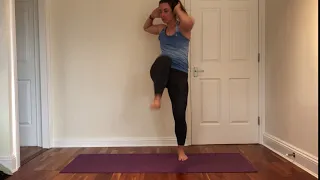
Standing cross crunch
Beginner
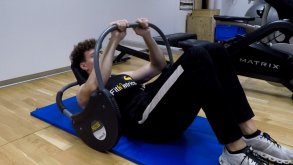
Ab crunch
Beginner
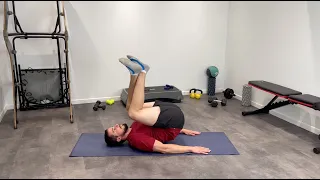
Reverse crunch
Beginner
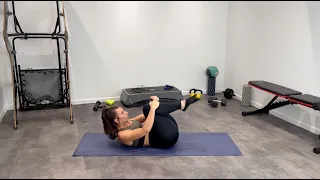
Tuck crunch
Beginner
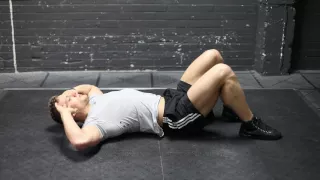
Cross-body crunch
Beginner
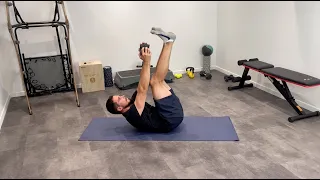
Dumbbell suitcase crunch
Intermediate
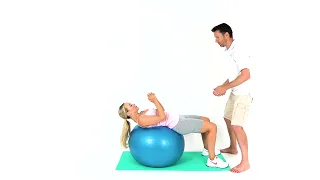
Stability ball overhead catch and throw crunch
Intermediate
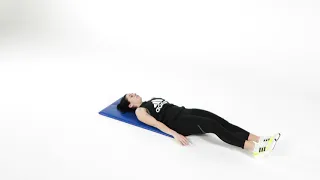
Cocoons
Beginner
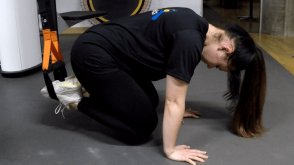
Trx abdominal crunch
Intermediate
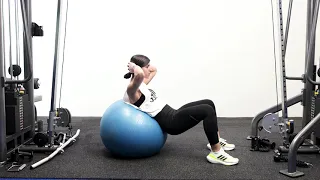
Swiss ball crunch
Beginner
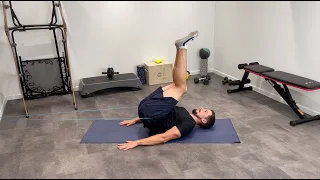
Banded reverse crunch
Beginner
Related fitness articles
See all
Body recomposition: lose fat while building muscle
Muscle gain

Fitness formulas: protein, water, creatine and caffeine
Muscle gain

Carb cycling: useful for losing weight and performing better?
Nutrition

Muscle failure in strength training: what the science says
Muscle gain

Peptides in bodybuilding: effectiveness and risks
Nutrition
Chest pump push-up workout
Muscle gain
Succeeding at your first pull-up
At the gym

Shoulder pain in weight training: prevention and solutions
Risk of injuries
Recommended by our experts
Receive your personalized program
Stop training at random.
Get my program- Program tailored to your profile
- Guided progression
- Compatible with your equipment
- Structured plan
Our coach prepares your program
Get my program