Standing Bird Dog
Demonstration video

Recommended by our experts
Receive your personalized program
Stop training at random.
Get my program- Program tailored to your profile
- Guided progression
- Compatible with your equipment
- Structured plan
Our coach prepares your program
Get my programHow to do Standing Bird Dog
Instructions
- Stand tall with your feet about hip-width apart.
- Brace your core and shift your weight onto one leg.
- Hinge forward at the hips while extending the other leg behind you.
- Reach the arm opposite the moving leg forward.
- Keep your hips level and continue until your torso and raised leg form a long line.
- Pause briefly, then return to the starting position with control.
- Complete the repetitions before switching sides.
Technical tips
- Keep a slight bend in the supporting knee.
- Maintain a neutral spine and avoid arching your lower back.
- Keep your pelvis facing the floor instead of rotating outward.
- Press the heel and the base of the big and little toes into the floor.
- Use only a range of motion you can control without losing balance.
Breathing tips
- Inhale before beginning the movement.
- Exhale as you extend your arm and leg.
- Breathe steadily while holding the extended position.
- Inhale as you return to standing.
Medical restrictions
- Acute hip, knee, ankle, or lower-back injury
- Uncontrolled vertigo or severe balance impairment
- Recent surgery affecting weight-bearing or trunk control
- Sharp pain during single-leg standing or hip hinging
Description
The Standing Bird Dog is a controlled single-leg exercise designed to develop whole-body coordination, postural awareness, and dynamic stability. It combines a balanced standing position with a contralateral reaching pattern, requiring the body to remain organized while the base of support becomes smaller. This makes the movement particularly valuable for improving control during everyday and athletic activities that involve walking, running, climbing stairs, changing direction, or transferring force between the upper and lower body.
Unlike a basic static balance drill, the Standing Bird Dog challenges stability while the limbs move through space. The extended position creates a longer lever, increasing the need for precise body awareness and smooth movement. Regular practice can improve proprioception, balance confidence, coordination, and the ability to maintain efficient alignment under changing conditions.
The exercise also develops resistance to unwanted rotation, an important quality for lifting, sports performance, and general movement efficiency. Because success depends on control rather than momentum, the Standing Bird Dog encourages deliberate movement and helps identify differences in balance or coordination between sides.
It is frequently included in functional fitness sessions, balance training, movement preparation, and corrective exercise programs. Its primary value is teaching the body to remain stable while opposite limbs move independently. This combination of coordination and single-leg control makes the Standing Bird Dog a practical exercise for building more confident, efficient, and resilient movement patterns.
Frequently asked questions
-
What are the benefits of doing the Standing Bird Dog?
The Standing Bird Dog improves single-leg balance, coordination, proprioception, postural control, and the ability to resist unwanted trunk rotation. -
What is the most common mistake in the Standing Bird Dog?
The most common mistake is opening the hips or arching the lower back to reach farther. A shorter, controlled range is more effective than losing alignment. -
Is the Standing Bird Dog safe for my lower back?
It is generally safe when performed with controlled movement and a comfortable range. Stop if you experience sharp pain, radiating symptoms, numbness, or increasing discomfort. -
How is the Standing Bird Dog different from the floor Bird Dog?
The standing version requires more single-leg balance and proprioception, while the floor Bird Dog provides a larger base of support and is usually easier for learning trunk control. -
How many Standing Bird Dog repetitions should I perform?
Start with 6 to 10 controlled repetitions per side. Prioritize stable, deliberate movement rather than performing a high number of fast repetitions.
Variants and alternatives
See all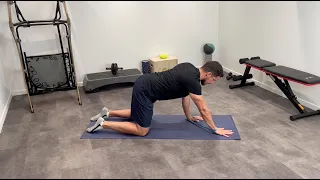
Related fitness articles
See all
Body recomposition: lose fat while building muscle
Muscle gain

Fitness formulas: protein, water, creatine and caffeine
Muscle gain

Carb cycling: useful for losing weight and performing better?
Nutrition

Muscle failure in strength training: what the science says
Muscle gain

Peptides in bodybuilding: effectiveness and risks
Nutrition
Chest pump push-up workout
Muscle gain
Succeeding at your first pull-up
At the gym

Shoulder pain in weight training: prevention and solutions
Risk of injuries
Recommended by our experts
Receive your personalized program
Stop training at random.
Get my program- Program tailored to your profile
- Guided progression
- Compatible with your equipment
- Structured plan
Our coach prepares your program
Get my program