Lateral Toe Tap
Demonstration video

Recommended by our experts
Receive your personalized program
Stop training at random.
Get my program- Program tailored to your profile
- Guided progression
- Compatible with your equipment
- Structured plan
Our coach prepares your program
Get my programHow to do Lateral Toe Tap
Instructions
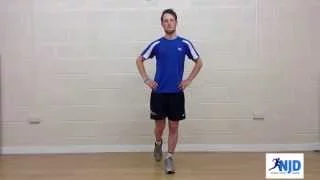
- Stand upright with your feet about hip-width apart and your knees slightly bent.
- Shift your body weight onto one leg while keeping your torso centered.
- Move the opposite foot out to the side and lightly touch the floor with your toes.
- Bring the tapping foot back to the starting position without losing your balance.
- Complete the repetitions on one side or alternate sides with each repetition.
Technical tips
- Keep most of your weight on the supporting leg.
- Touch the floor lightly instead of transferring your weight onto the tapping foot.
- Keep the supporting knee aligned with the toes.
- Maintain an upright torso and avoid leaning toward the tapping foot.
- Use a controlled range of motion that allows you to remain stable.
Breathing tips
- Inhale while returning the foot to the starting position.
- Exhale as you tap the foot out to the side.
- Maintain steady breathing and avoid holding your breath.
Medical restrictions
- Acute ankle sprain or significant ankle instability
- Acute hip or knee pain aggravated by lateral movement
- Recent lower-limb surgery without medical clearance
- Severe balance impairment or uncontrolled vertigo without supervision
Description
The Lateral Toe Tap is a simple standing exercise designed to develop control during side-to-side movement. It requires no equipment and can be performed in a small space, making it suitable for home workouts, gym warm-ups, beginner fitness sessions, and low-impact training programs.
The exercise introduces lateral movement without requiring a large step, jump, or complete transfer of body weight. This makes it an accessible way to practise stability and coordination before progressing to more demanding movements such as lateral lunges, skater steps, agility drills, or multidirectional conditioning exercises. The controlled toe contact also encourages greater awareness of foot placement and body position.
Regular practice can improve balance on one leg, movement confidence, rhythm, and coordination between the upper and lower body. It may also help prepare the body for activities that involve changing direction, moving around obstacles, or maintaining control while reaching outside the normal base of support.
The Lateral Toe Tap can be performed slowly as a control-focused drill or at a quicker rhythm to increase overall movement intensity. Because the range of motion is easy to adjust, it can be adapted for different fitness levels. Beginners can use a small tapping distance and a stable support nearby, while more experienced users can increase the distance, tempo, or complexity. Its low-impact nature makes it a practical addition to general fitness routines, active recovery sessions, balance training, and movement preparation.
Frequently asked questions
-
What benefits can I get from lateral toe taps?
Lateral toe taps can improve side-to-side coordination, single-leg stability, foot placement, balance, and confidence during lateral movement. -
How do I avoid the most common lateral toe tap mistake?
Avoid shifting your full body weight onto the tapping foot. Keep the contact light, maintain control through the supporting leg, and keep your torso upright. -
Are lateral toe taps safe if I have knee pain?
They are generally low impact, but you should reduce the tapping distance and stop if the movement increases knee pain. Persistent or sharp pain should be assessed by a qualified healthcare professional. -
How many lateral toe taps should I do?
A practical starting point is 10 to 15 repetitions per side or 20 to 40 seconds of controlled alternating taps.
Variants and alternatives
See all
Related fitness articles
See all
Body recomposition: lose fat while building muscle
Muscle gain

Fitness formulas: protein, water, creatine and caffeine
Muscle gain

Carb cycling: useful for losing weight and performing better?
Nutrition

Muscle failure in strength training: what the science says
Muscle gain

Peptides in bodybuilding: effectiveness and risks
Nutrition
Chest pump push-up workout
Muscle gain
Succeeding at your first pull-up
At the gym

Shoulder pain in weight training: prevention and solutions
Risk of injuries
Recommended by our experts
Receive your personalized program
Stop training at random.
Get my program- Program tailored to your profile
- Guided progression
- Compatible with your equipment
- Structured plan
Our coach prepares your program
Get my program