Dumbbell Close-Grip Floor Press
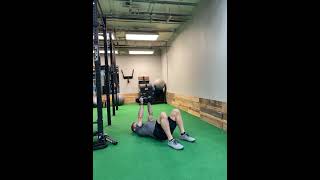
Demonstration video
Recommended by our experts
Receive your personalized program
Stop training at random.
Get my program- Program tailored to your profile
- Guided progression
- Compatible with your equipment
- Structured plan
Our coach prepares your program
Get my programHow to do Dumbbell Close-Grip Floor Press
Instructions
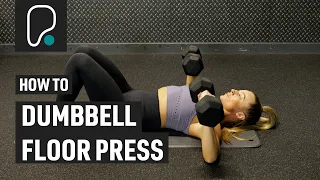
- Lie on your back with your knees bent and your feet flat on the floor.
- Hold one dumbbell in each hand with your palms facing each other.
- Position the dumbbells together above your chest and apply gentle inward pressure.
- Lower the dumbbells under control while keeping your elbows close to your torso.
- Stop when your upper arms lightly touch the floor.
- Pause briefly, then press the dumbbells upward until your arms are extended.
- Keep the dumbbells together throughout the repetition.
Technical tips
- Keep your wrists straight and directly above your elbows.
- Maintain steady inward pressure between the dumbbells.
- Keep your shoulder blades stable against the floor.
- Touch the floor gently rather than bouncing your upper arms.
- Avoid excessively flaring your elbows.
- Finish each repetition without forcefully locking your elbows.
Breathing tips
- Inhale as you lower the dumbbells.
- Brace your torso briefly at the bottom.
- Exhale as you press the dumbbells upward.
Medical restrictions
- Acute shoulder, elbow, or wrist injury
- Recent chest, shoulder, or arm surgery without medical clearance
- Painful inability to lie flat on the floor
Description
The Dumbbell Close-Grip Floor Press is a compact upper-body pressing variation performed while lying on the floor and holding two dumbbells together. Its shortened range of motion makes it useful for developing pressing strength while limiting the deepest portion of the descent. This can make the movement easier to control than many bench-based presses and allows lifters to train effectively with minimal equipment.
Keeping the dumbbells close creates continuous inward pressure, adding a strong stabilization demand throughout each repetition. The floor provides a consistent stopping point, which helps standardize depth and encourages deliberate pauses rather than relying on momentum. Because the body is supported, the exercise also reduces lower-body contribution and keeps the effort focused on the pressing action.
This exercise is particularly useful in home workouts, minimalist strength programs, and sessions where a bench is unavailable. It can also serve as an accessory movement for improving lockout strength, building control near the top half of a press, and adding training volume without requiring very heavy loads. The neutral hand position commonly used with this variation may feel more comfortable for many lifters than a fully pronated grip.
Overall, the Dumbbell Close-Grip Floor Press is an efficient, accessible, and highly repeatable exercise for improving upper-body strength, muscular control, and pressing endurance.
Frequently asked questions
-
What are the benefits of doing the Dumbbell Close-Grip Floor Press?
It develops upper-body pressing strength, improves lockout power, promotes muscular control, and provides an effective dumbbell pressing option when a bench is unavailable. -
What is the most common mistake I should avoid during the Dumbbell Close-Grip Floor Press?
The most common mistake is allowing the dumbbells to separate or the elbows to flare outward, which reduces the close-grip emphasis and can make the movement less stable. -
Is the Dumbbell Close-Grip Floor Press safe for my shoulders?
The floor limits the deepest part of the press, which may reduce shoulder stress for some people. Stop if you experience pain and seek professional guidance for an existing injury. -
How is the close-grip version different from a standard Dumbbell Floor Press?
The close-grip version keeps the dumbbells together and the elbows nearer the torso, increasing the demand on the triceps and inward pressing control. The standard version allows a wider arm position and less continuous inward pressure.
Variants and alternatives
See all
Related programs
See all
Related fitness articles
See all
Body recomposition: lose fat while building muscle
Muscle gain

Fitness formulas: protein, water, creatine and caffeine
Muscle gain

Carb cycling: useful for losing weight and performing better?
Nutrition

Muscle failure in strength training: what the science says
Muscle gain

Peptides in bodybuilding: effectiveness and risks
Nutrition
Chest pump push-up workout
Muscle gain
Succeeding at your first pull-up
At the gym

Shoulder pain in weight training: prevention and solutions
Risk of injuries
Recommended by our experts
Receive your personalized program
Stop training at random.
Get my program- Program tailored to your profile
- Guided progression
- Compatible with your equipment
- Structured plan
Our coach prepares your program
Get my program