Lower body – enduring legs and short circuit
13 Exercises
Intro
Required equipment
Muscles
Standard
Warm-up
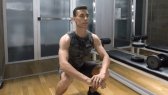
Use a comfortable range of motion and a smooth pace to prepare your knees and hips. If your mobility is limited, slightly reduce the depth. Read more Read less
Use a comfortable range of motion and a smooth pace to prepare your knees and hips. If your mobility is limited, slightly reduce the depth.
12 - 15 Repetitions
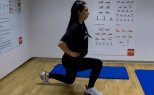
Alternate legs and keep the front foot stable. Start with a moderate range of motion; if balance limits the movement, use light support. Read more Read less
Alternate legs and keep the front foot stable. Start with a moderate range of motion; if balance limits the movement, use light support.
8 - 10 Repetitions
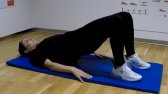
Squeeze your glutes at the top without arching your lower back. If your hamstrings cramp, bring your feet slightly closer to your hips. Read more Read less
Squeeze your glutes at the top without arching your lower back. If your hamstrings cramp, bring your feet slightly closer to your hips.
12 - 15 Repetitions
Standard
Main
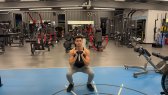
Choose a load that lets you keep about 2 repetitions in reserve during longer sets. Keep your whole foot on the floor; if depth compromises your posture, reduce the range of motion. If the next dumbbell increment is substantially greater than 5%, keep the same load and consolidate the top of the range before using the smallest available increment. Read more Read less
Choose a load that lets you keep about 2 repetitions in reserve during longer sets. Keep your whole foot on the floor; if depth compromises your posture, reduce the range of motion. If the next dumbbell increment is substantially greater than 5%, keep the same load and consolidate the top of the range before using the smallest available increment.
Set
1: 12 - 18 Repetitions
Rest time : 1 minute
Set
2: 12 - 18 Repetitions
Rest time : 1 minute
Set
3: 12 - 18 Repetitions
Rest time : 1 minute
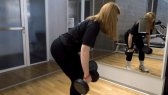
Push your hips back with a neutral spine and keep the dumbbells close to your legs. Stop the descent as soon as your back position starts to break down; a shorter range of motion is better than a forced repetition. If the next dumbbell increment is substantially greater than 5%, keep the same load and consolidate the top of the range before using the smallest available increment. Read more Read less
Push your hips back with a neutral spine and keep the dumbbells close to your legs. Stop the descent as soon as your back position starts to break down; a shorter range of motion is better than a forced repetition. If the next dumbbell increment is substantially greater than 5%, keep the same load and consolidate the top of the range before using the smallest available increment.
Set
1: 12 - 15 Repetitions
Rest time : 1 minute
Set
2: 12 - 15 Repetitions
Rest time : 1 minute
Set
3: 12 - 15 Repetitions
Rest time : 1 minute
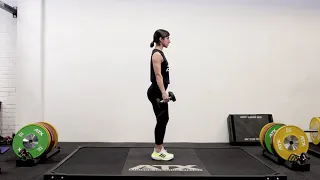
Count the repetition range per leg and use a long enough stride to remain stable. If your knees or balance limit the effort, reduce the load or use one hand for support. If the next dumbbell increment is substantially greater than 5%, keep the same load and consolidate the top of the range before using the smallest available increment. Read more Read less
Count the repetition range per leg and use a long enough stride to remain stable. If your knees or balance limit the effort, reduce the load or use one hand for support. If the next dumbbell increment is substantially greater than 5%, keep the same load and consolidate the top of the range before using the smallest available increment.
Set
1: 10 - 15 Repetitions
Rest time : 50 seconds
Set
2: 10 - 15 Repetitions
Rest time : 50 seconds
Set
3: 10 - 15 Repetitions
Rest time : 1 minute
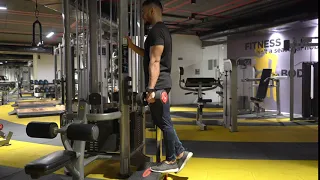
Train each calf separately with a brief pause at the top and a controlled lowering phase. Hold on to a stable support if necessary; if balance becomes the limiting factor, perform Standing Dumbbell Calf Raise. Read more Read less
Train each calf separately with a brief pause at the top and a controlled lowering phase. Hold on to a stable support if necessary; if balance becomes the limiting factor, perform Standing Dumbbell Calf Raise.
Set
1: 15 - 25 Repetitions
Rest time : 40 seconds
Set
2: 15 - 25 Repetitions
Rest time : 40 seconds
Set
3: 15 - 25 Repetitions
Rest time : 45 seconds
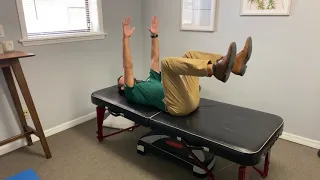
Count repetitions per side and keep your lower back in contact with the floor. Reduce the leg range of motion if your lower back arches; extend your limbs farther only when you can maintain control. Read more Read less
Count repetitions per side and keep your lower back in contact with the floor. Reduce the leg range of motion if your lower back arches; extend your limbs farther only when you can maintain control.
Set
1: 10 - 15 Repetitions
Rest time : 35 seconds
Set
2: 10 - 15 Repetitions
Rest time : 1 minute
Circuit
3 rounds
Main
Do each exercise one after another. When you finish the list, rest then start again.
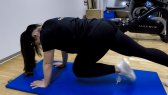
Count each knee drive as one repetition. Keep your shoulders stable and your hips controlled. In the circuit, first aim for 40 clean repetitions on every round; then use a cross-body or more challenging variation rather than automatically increasing the load. Read more Read less
Count each knee drive as one repetition. Keep your shoulders stable and your hips controlled. In the circuit, first aim for 40 clean repetitions on every round; then use a cross-body or more challenging variation rather than automatically increasing the load.
Round
1: 24 - 40 Repetitions
Round
2: 24 - 40 Repetitions
Round
3: 24 - 40 Repetitions
Chain without rest
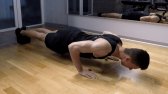
Maintain a repeatable range of motion and keep your body aligned. Use your knees or a very sturdy chair if necessary. Once you reach 15 clean repetitions on every round, choose a slightly harder variation instead of automatically adding 5% load. Read more Read less
Maintain a repeatable range of motion and keep your body aligned. Use your knees or a very sturdy chair if necessary. Once you reach 15 clean repetitions on every round, choose a slightly harder variation instead of automatically adding 5% load.
Round
1: 8 - 15 Repetitions
Round
2: 8 - 15 Repetitions
Round
3: 8 - 15 Repetitions
Chain without rest
Keep your feet stable, your knees aligned, and use a range of motion you can repeat across all three rounds. Once you reach 25 clean repetitions on every round, increase the difficulty through tempo control or a more challenging variation, without automatically adding load. Read more Read less
Keep your feet stable, your knees aligned, and use a range of motion you can repeat across all three rounds. Once you reach 25 clean repetitions on every round, increase the difficulty through tempo control or a more challenging variation, without automatically adding load.
Round
1: 15 - 25 Repetitions
Rest time : 1 minute
Round
2: 15 - 25 Repetitions
Rest time : 1 minute
Round
3: 15 - 25 Repetitions
Rest time : 1 minute
1 minute rest between each round
Repeat 3 times
1 minute rest
Standard
Cool-down

Gently stretch the front of your thigh without pulling on the knee. Hold on to a support if necessary so balance does not limit the stretch. Read more Read less
Gently stretch the front of your thigh without pulling on the knee. Hold on to a support if necessary so balance does not limit the stretch.
25 seconds - 35 seconds
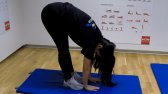
Keep your back long and hinge forward at the hips until you feel mild tension in the back of the thigh. Do not force the range of motion if your lower back starts to round. Read more Read less
Keep your back long and hinge forward at the hips until you feel mild tension in the back of the thigh. Do not force the range of motion if your lower back starts to round.
25 seconds - 35 seconds
This workout is part of a complete program.
View program