Single-Leg Dumbbell Calf Raise
Demonstration video

Recommended by our experts
Receive your personalized program
Stop training at random.
Get my program- Program tailored to your profile
- Guided progression
- Compatible with your equipment
- Structured plan
Our coach prepares your program
Get my programHow to do Single-Leg Dumbbell Calf Raise
Instructions
- Stand upright on one leg while holding a dumbbell and keep your working foot flat on the floor.
- Keep your torso tall and your working knee straight but not locked.
- Press through the ball of your foot and raise your heel as high as comfortably possible.
- Pause briefly at the top and fully contract your calf.
- Lower your heel slowly until you return to the starting position.
- Complete the prescribed repetitions, then switch legs.
Technical tips
- Keep your ankle aligned and avoid letting it roll excessively inward or outward.
- Move through the ankle rather than bouncing or using momentum.
- Maintain even pressure through the ball of the foot, especially around the base of the big toe.
- Use a stable support with your free hand if balance limits your calf training.
- Control the lowering phase to maintain tension through the calf.
Breathing tips
- Exhale as you raise your heel and contract the calf.
- Inhale as you slowly lower your heel.
- Keep your breathing steady and avoid holding your breath during repetitions.
Medical restrictions
- Avoid or modify this exercise with acute Achilles tendon pain or injury.
- Avoid loading the movement during an acute ankle sprain or significant ankle instability.
- Use medical guidance if recovering from recent foot, ankle, or calf surgery.
- Stop if the exercise causes sharp pain in the ankle, Achilles tendon, foot, or calf.
Description
The Single-Leg Standing Dumbbell Calf Raise is a unilateral strength exercise that develops the calf muscles through loaded ankle plantar flexion. Training one leg at a time allows each side to work independently, which can help address strength differences while increasing the loading challenge without requiring heavy equipment. The exercise also demands ankle control and lower-body stability, making it useful for building stronger calves for bodybuilding, general fitness, and everyday movement.
Frequently asked questions
-
What are the benefits of doing Single-Leg Dumbbell Calf Raises?
Single-Leg Dumbbell Calf Raises strengthen and develop the calves while training each leg independently. They can help improve calf size, plantar-flexion strength, ankle control, and side-to-side muscular balance. -
What is the most common mistake when I do a Single-Leg Dumbbell Calf Raise?
A common mistake is bouncing through the repetitions instead of controlling the ankle. Raise the heel deliberately, pause briefly at the top, and lower under control to keep tension on the calf. -
Is the Single-Leg Dumbbell Calf Raise safe for my ankles and Achilles tendon?
It is generally safe when performed with controlled motion and an appropriate load. Avoid forcing the range of motion or using excessive weight, and stop if you experience sharp ankle, foot, calf, or Achilles tendon pain. -
What muscles do I work with a Single-Leg Dumbbell Calf Raise?
The exercise primarily targets the calf muscles responsible for plantar flexion. The foot and ankle stabilizers, gluteus medius, and gripping muscles of the forearm also contribute to maintaining balance and holding the dumbbell. -
How is the Single-Leg Dumbbell Calf Raise different from a regular Standing Dumbbell Calf Raise?
The single-leg version places the body's weight and dumbbell resistance on one calf at a time, creating a greater relative challenge and making muscular imbalances easier to identify. The bilateral version generally requires less balance and can be easier to load progressively. -
How can I make the Single-Leg Dumbbell Calf Raise harder?
Increase the dumbbell load gradually, perform more repetitions within your target range, slow the lowering phase, or perform the exercise on a stable step to increase the available range of motion.
Variants and alternatives
See all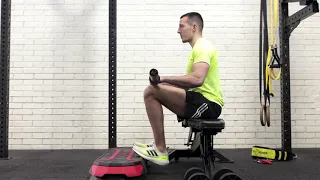
Barbell seated calf raise
Beginner
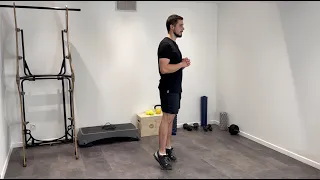
Calf raises
Beginner
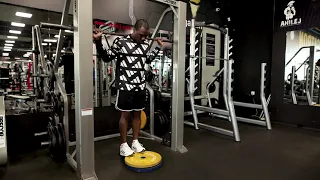
Smith machine calf raises
Beginner
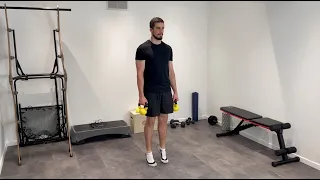
Kettlebell calf raise
Beginner
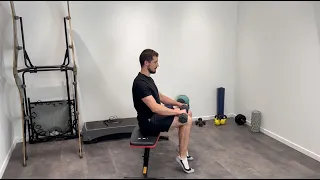
Seated calf raise with dumbbells
Beginner

Deep squat hold calf raise
Intermediate
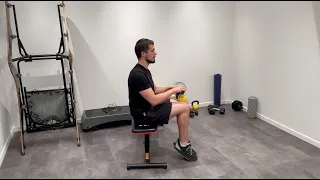
Seated calf raise with kettlebell
Beginner
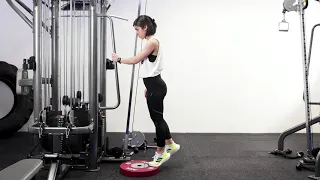
Single leg calf raise
Intermediate
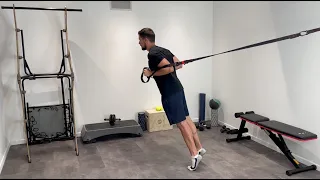
Trx calf raise
Beginner
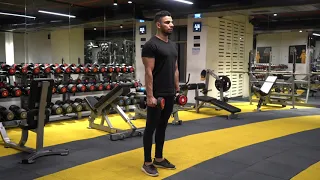
Dumbbell standing calf raise
Beginner

Standing calf raises
Beginner
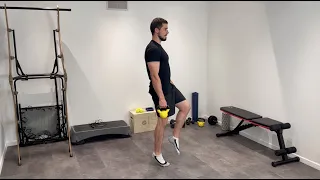
Kettlebell single leg calf raise
Intermediate
Related programs
See all

Related fitness articles
See all
Body recomposition: lose fat while building muscle
Muscle gain

Fitness formulas: protein, water, creatine and caffeine
Muscle gain

Carb cycling: useful for losing weight and performing better?
Nutrition

Muscle failure in strength training: what the science says
Muscle gain

Peptides in bodybuilding: effectiveness and risks
Nutrition
Chest pump push-up workout
Muscle gain
Succeeding at your first pull-up
At the gym

Shoulder pain in weight training: prevention and solutions
Risk of injuries
Recommended by our experts
Receive your personalized program
Stop training at random.
Get my program- Program tailored to your profile
- Guided progression
- Compatible with your equipment
- Structured plan
Our coach prepares your program
Get my program