Full Planche
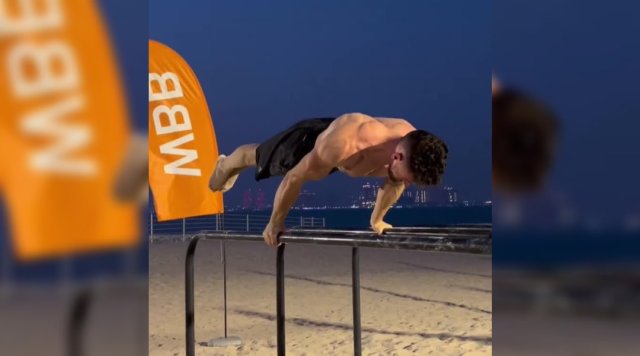
Demonstration video
Recommended by our experts
Receive your personalized program
Stop training at random.
Get my program- Program tailored to your profile
- Guided progression
- Compatible with your equipment
- Structured plan
Our coach prepares your program
Get my programHow to do Full Planche
Instructions
- Place your hands on the floor or dips bars slightly wider than shoulder-width.
- Lock your elbows and actively push the ground away to protract your shoulder blades.
- Lean your shoulders forward past your hands while keeping your arms straight.
- Lift both feet off the ground and extend your body into one straight horizontal line.
- Keep your hips level, legs together, toes pointed, and body fully tense.
- Hold the position for the prescribed time, then lower with control.
Technical tips
- Keep your elbows fully locked throughout the hold.
- Push tall through the shoulders instead of sinking between your arms.
- Posteriorly tilt your pelvis to avoid arching your lower back.
- Keep your legs straight and squeezed together for maximum body tension.
- Use planche progressions before attempting the full version.
- Stop the set when your hips drop or your elbows bend.
Breathing tips
- Take a deep breath before lifting into the hold.
- Use short, controlled breaths while maintaining full-body tension.
- Avoid holding your breath for the entire set.
- Exhale slowly as you lower out of the position.
Medical restrictions
- Avoid this exercise with active wrist pain, wrist sprains, or carpal tunnel symptoms.
- Avoid this exercise with shoulder instability, rotator cuff injury, or painful impingement symptoms.
- Avoid this exercise with elbow tendinopathy or pain during straight-arm loading.
- Avoid this exercise with uncontrolled lower back pain or inability to maintain pelvic control.
- Do not attempt this exercise without sufficient straight-arm strength and planche progression experience.
Description
The full planche is one of the most demanding bodyweight strength skills in calisthenics. It requires the athlete to hold the entire body parallel to the floor with only the hands in contact with the ground or dips bars. Unlike basic support holds, the full planche places the body in a long lever position, making it an elite test of control, tension, and positional strength.
This exercise is highly valued because it develops exceptional straight-arm strength, total-body coordination, and advanced balance. It teaches the body to generate force while staying rigid from shoulders to toes, which carries over to other high-level calisthenics skills such as planche push-ups, press handstands, handstand work, and static strength holds.
The full planche is best trained as a skill-strength movement rather than a casual conditioning exercise. Quality, alignment, and progressive overload matter more than long hold times. Most athletes build toward it through planche leans, tuck planches, advanced tuck planches, and straddle planches before attempting the full position. Because of its difficulty, it rewards patience, precise technique, and consistent practice. When performed correctly, the full planche is a powerful benchmark of upper-body strength, body control, and advanced calisthenics performance.
Frequently asked questions
-
What are the benefits of doing the full planche?
The full planche builds elite bodyweight strength, straight-arm control, balance, and full-body tension. It is also a key benchmark skill in advanced calisthenics training. -
What muscles does the full planche work?
The full planche mainly targets the shoulders, chest, and abs, while the triceps, serratus anterior, forearms, glutes, and lower back help stabilize the hold. -
What is the most common mistake in the full planche?
The most common mistake is letting the hips drop or the lower back arch. A correct full planche requires a straight body line, locked elbows, strong shoulder protraction, and tight core control. -
Is the full planche safe for my wrists and shoulders?
The full planche can be safe for trained athletes, but it places very high stress on the wrists, elbows, and shoulders. Use gradual progressions, warm up thoroughly, and stop if you feel sharp joint pain. -
How long should I hold a full planche?
A clean hold of 3 to 5 seconds is already advanced. Build duration slowly with perfect form before increasing total training volume. -
Is the full planche harder than the straddle planche?
Yes. The full planche is harder because the legs are together and fully extended, creating a longer lever. The straddle planche reduces leverage demands by spreading the legs. -
Can I train the full planche without equipment?
Yes. You can train the full planche on the floor without equipment, but dips bars may reduce wrist extension stress and provide a more comfortable grip for some athletes.
Variants and alternatives
See all
Related fitness articles
See all
Body recomposition: lose fat while building muscle
Muscle gain

Fitness formulas: protein, water, creatine and caffeine
Muscle gain

Carb cycling: useful for losing weight and performing better?
Nutrition
Muscle failure in strength training: what the science says
Muscle gain

Peptides in bodybuilding: effectiveness and risks
Nutrition
Chest pump push-up workout
Muscle gain
Succeeding at your first pull-up
At the gym

Shoulder pain in weight training: prevention and solutions
Risk of injuries
Recommended by our experts
Receive your personalized program
Stop training at random.
Get my program- Program tailored to your profile
- Guided progression
- Compatible with your equipment
- Structured plan
Our coach prepares your program
Get my program