Single Leg Balance
Demonstration video

Recommended by our experts
Receive your personalized program
Stop training at random.
Get my program- Program tailored to your profile
- Guided progression
- Compatible with your equipment
- Structured plan
Our coach prepares your program
Get my programHow to do Single Leg Balance
Instructions
- Stand upright with feet hip-width apart.
- Shift your weight onto one leg.
- Lift the opposite foot slightly off the ground.
- Maintain balance while keeping your torso upright.
- Hold the position for the desired time, then switch sides.
Technical tips
- Keep your gaze fixed on a point to improve stability.
- Engage your core to maintain control and alignment.
- Avoid locking the standing knee; keep it slightly bent.
- Keep hips level and avoid leaning to one side.
Breathing tips
- Breathe steadily and naturally throughout the hold.
- Avoid holding your breath to maintain relaxation and control.
Medical restrictions
- Acute ankle sprain or instability
- Recent knee or hip injury
- Severe balance disorders or vertigo
- Post-surgical lower limb conditions without medical clearance
Description
The Single Leg Stand is a foundational balance exercise widely used in fitness, rehabilitation, and functional training programs. It focuses on improving stability, coordination, and body awareness by challenging your ability to maintain control on one leg. This simple yet highly effective movement is often included in warm-ups, injury prevention routines, and mobility sessions.
By reducing your base of support, the exercise forces your body to stabilize itself efficiently, enhancing neuromuscular coordination and joint control. It is particularly valuable for improving everyday functional movements such as walking, running, and changing direction. Athletes and beginners alike benefit from incorporating this movement into their routine due to its accessibility and scalability.
The Single Leg Stand also plays a key role in developing proprioception, which is your body's ability to sense position and movement. Improved proprioception contributes to better balance, reduced risk of falls, and enhanced overall performance in both sports and daily activities.
Another major advantage of this exercise is its versatility. It can be performed anywhere without equipment and easily progressed by adding variations such as closing the eyes or performing controlled movements while balancing. Whether used for rehabilitation, performance enhancement, or general fitness, the Single Leg Stand remains a cornerstone exercise for building stability and control.
Frequently asked questions
-
What are the benefits of doing a single leg stand?
The single leg stand improves balance, coordination, and stability while enhancing proprioception and reducing the risk of falls or injuries. It also supports better movement control in daily activities and sports. -
What is the most common mistake when doing a single leg stand?
A common mistake is letting the hips drop or leaning excessively to one side. Maintaining an upright posture and keeping the hips level ensures proper alignment and effectiveness. -
Is the single leg stand safe for beginners?
Yes, the single leg stand is safe for beginners when performed on a stable surface. Using support like a wall or chair can help improve confidence and reduce the risk of losing balance. -
How long should I hold a single leg stand?
Most people benefit from holding a single leg stand for 20 to 60 seconds per side. Duration can be increased gradually as balance and stability improve. -
Is the single leg stand with eyes closed more effective?
Yes, performing the single leg stand with eyes closed increases the difficulty by removing visual input, which enhances proprioception and balance control compared to the standard version.
Variants and alternatives
See all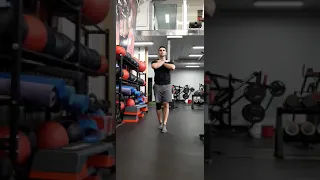
Related fitness articles
See all
Body recomposition: lose fat while building muscle
Muscle gain

Fitness formulas: protein, water, creatine and caffeine
Muscle gain

Carb cycling: useful for losing weight and performing better?
Nutrition
Muscle failure in strength training: what the science says
Muscle gain

Peptides in bodybuilding: effectiveness and risks
Nutrition
Chest pump push-up workout
Muscle gain
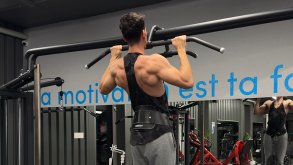
Succeeding at your first pull-up
At the gym

Shoulder pain in weight training: prevention and solutions
Risk of injuries
Recommended by our experts
Receive your personalized program
Stop training at random.
Get my program- Program tailored to your profile
- Guided progression
- Compatible with your equipment
- Structured plan
Our coach prepares your program
Get my program