Demonstration video
Receive your personalized program
Stop training at random.
Get my programGet a program adapted to your goals, level, and available equipment. Reach your goals faster with a structured plan designed just for you.
- Program tailored to your profile
- Guided progression
- Compatible with your equipment
- Structured plan
Our coach prepares your program
Get my programHow to do the dumbbell floor press
Instructions
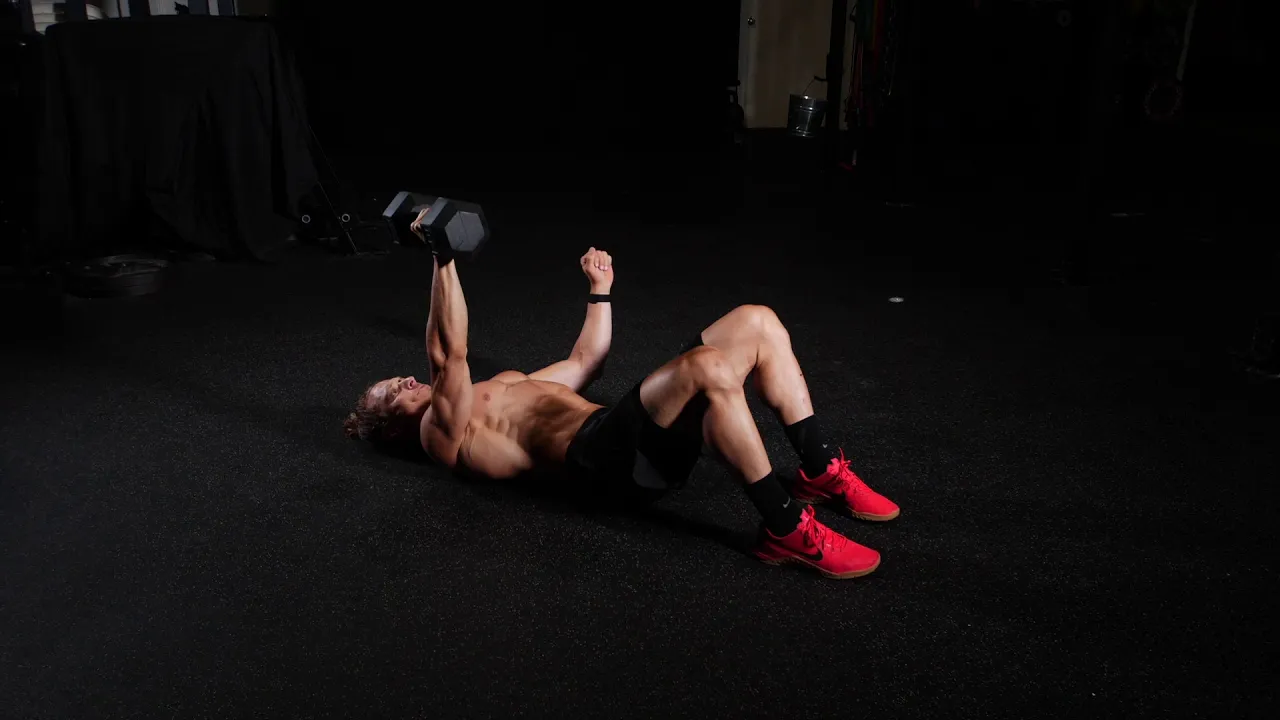
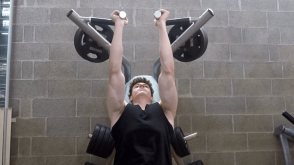
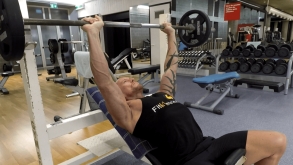
- Lie on your back on a yoga mat with your knees bent and feet flat on the floor.
- Hold a dumbbell in each hand with your upper arms resting on the floor and your elbows bent.
- Set your shoulders down and back, and keep your wrists stacked over your elbows.
- Press the dumbbells straight up until your arms are fully extended above your chest.
- Pause briefly at the top without letting the weights drift forward.
- Lower the dumbbells under control until your upper arms gently touch the floor, then repeat.
Technical tips
- Keep your forearms vertical at the bottom for stronger pressing mechanics.
- Lightly touch the floor with your upper arms instead of bouncing off it.
- Maintain a neutral wrist position throughout the movement.
- Brace your core and keep your rib cage from flaring as you press.
- Move both dumbbells at the same speed to stay balanced.
Breathing tips
- Inhale as you lower the dumbbells to the floor.
- Exhale as you press the dumbbells up.
- Take a small breath and brace before each rep for better stability.
Medical restrictions
- Acute shoulder pain or shoulder impingement
- Recent pec or triceps strain
- Uncontrolled elbow or wrist pain
- Recent upper-body surgery
- Neck pain aggravated by lying flat
Description
The dumbbell floor press is a practical upper-body pressing exercise that builds pressing strength with a shorter range of motion than a traditional bench press. Because you perform it lying on the floor, the movement naturally limits how far the elbows travel, which makes it a popular option for learning better control and improving lockout strength. Many lifters use the dumbbell floor press to develop solid pressing mechanics, train hard without a bench, or add variety to their workout routine.
This exercise is especially useful for home workouts because it requires minimal setup and only a pair of dumbbells and a mat. It also encourages better tension and body awareness, since you have to control each weight independently from start to finish. That makes it effective for improving coordination, reducing side-to-side imbalances, and building confidence with dumbbell pressing.
Another major benefit of the dumbbell floor press is its versatility. It can be used by beginners who want a more manageable pressing pattern, as well as experienced lifters who want extra volume without the deeper stretch of a full bench press. It fits well in strength-focused sessions, muscle-building programs, and minimalist training plans. If you want a reliable pressing movement that is simple, scalable, and easy to perform almost anywhere, the dumbbell floor press is one of the best options to include in your routine.
Read more
Read less
Description
The dumbbell floor press is a practical upper-body pressing exercise that builds pressing strength with a shorter range of motion than a traditional bench press. Because you perform it lying on the floor, the movement naturally limits how far the elbows travel, which makes it a popular option for learning better control and improving lockout strength. Many lifters use the dumbbell floor press to develop solid pressing mechanics, train hard without a bench, or add variety to their workout routine. This exercise is especially useful for home workouts because it requires minimal setup and only a pair of dumbbells and a mat. It also encourages better tension and body awareness, since you have to control each weight independently from start to finish. That makes it effective for improving coordination, reducing side-to-side imbalances, and building confidence with dumbbell pressing. Another major benefit of the dumbbell floor press is its versatility. It can be used by beginners who want a more manageable pressing pattern, as well as experienced lifters who want extra volume without the deeper stretch of a full bench press. It fits well in strength-focused sessions, muscle-building programs, and minimalist training plans. If you want a reliable pressing movement that is simple, scalable, and easy to perform almost anywhere, the dumbbell floor press is one of the best options to include in your routine.
Read more Read lessFAQ