Band Scaption
Demonstration video
Recommended by our experts
Receive your personalized program
Stop training at random.
Get my program- Program tailored to your profile
- Guided progression
- Compatible with your equipment
- Structured plan
Our coach prepares your program
Get my programHow to do Band Scaption
Instructions
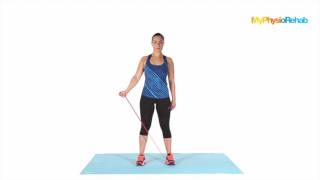
- Stand on the center of the resistance band with feet hip-width apart.
- Hold one end of the band in each hand with thumbs pointing upward.
- Keep a slight bend in your elbows throughout the movement.
- Raise your arms about 30–45 degrees in front of your body until shoulder height.
- Pause briefly at the top without shrugging your shoulders.
- Lower your arms slowly to the starting position under control.
Technical tips
- Maintain a neutral spine and brace your core.
- Lead the movement with your shoulders, not your upper traps.
- Keep your thumbs pointing upward during the lift.
- Move slowly and avoid using momentum.
- Stop at shoulder height unless otherwise instructed by a professional.
Breathing tips
- Exhale as you raise the band.
- Inhale while lowering under control.
- Maintain steady breathing and avoid holding your breath.
Medical restrictions
- Acute shoulder injury or severe shoulder pain.
- Recent rotator cuff surgery unless cleared by a healthcare professional.
- Acute shoulder impingement symptoms.
- Uncontrolled pain during arm elevation.
Description
The Resistance Band Scaption is an effective shoulder strengthening exercise performed by lifting the arms in the scapular plane, approximately 30 to 45 degrees in front of the body. This movement closely follows the shoulder's natural biomechanics, making it a popular choice for improving upper-body function, posture, and movement quality. Because resistance bands provide progressive tension throughout the range of motion, the exercise offers a smooth and controlled loading pattern that is suitable for beginners, athletes, and individuals returning to training. Regularly incorporating band scaption into a workout routine can improve shoulder control, increase movement efficiency, and enhance overhead performance in daily activities and sports. It is commonly included in warm-ups, prehabilitation routines, and general strength programs because it reinforces proper movement mechanics while using relatively low joint stress. The exercise also promotes balanced shoulder development by encouraging controlled lifting rather than relying on momentum. Resistance bands are portable, inexpensive, and easy to adjust, making this exercise practical for home workouts, gym sessions, or travel. Whether your goal is building healthier shoulders, improving exercise technique, or supporting long-term upper-body performance, the Resistance Band Scaption is a versatile movement that fits well into most training plans. Consistent practice with appropriate resistance and controlled execution helps reinforce quality movement patterns that contribute to better overall shoulder function and exercise performance.
Frequently asked questions
-
What are the benefits of doing the Resistance Band Scaption?
Resistance Band Scaption helps improve shoulder strength, control, posture, and overhead movement while providing smooth resistance that is suitable for warm-ups, rehabilitation, and general fitness. -
What is the most common mistake when performing Resistance Band Scaption?
The most common mistake is shrugging the shoulders or using momentum instead of lifting with controlled movement. Keeping the motion slow and stopping around shoulder height improves exercise quality. -
Is Resistance Band Scaption safe for my shoulders?
For most healthy individuals, yes. Using light resistance, controlled technique, and a pain-free range of motion makes it a shoulder-friendly exercise. If you have an existing shoulder injury, consult a healthcare professional first. -
Should I choose Resistance Band Scaption or Dumbbell Scaption?
Resistance Band Scaption provides increasing tension throughout the lift and is often easier on the joints, while Dumbbell Scaption offers constant resistance and may be better for progressive strength development. -
How many sets and reps should I do for Resistance Band Scaption?
A common recommendation is 2 to 4 sets of 10 to 15 controlled repetitions using a resistance level that allows perfect technique.
Related fitness articles
See all
Body recomposition: lose fat while building muscle
Muscle gain

Fitness formulas: protein, water, creatine and caffeine
Muscle gain

Carb cycling: useful for losing weight and performing better?
Nutrition

Muscle failure in strength training: what the science says
Muscle gain

Peptides in bodybuilding: effectiveness and risks
Nutrition
Chest pump push-up workout
Muscle gain
Succeeding at your first pull-up
At the gym

Shoulder pain in weight training: prevention and solutions
Risk of injuries
Recommended by our experts
Receive your personalized program
Stop training at random.
Get my program- Program tailored to your profile
- Guided progression
- Compatible with your equipment
- Structured plan
Our coach prepares your program
Get my program