Bodyweight Lying Reverse Fly
Demonstration video

Recommended by our experts
Receive your personalized program
Stop training at random.
Get my program- Program tailored to your profile
- Guided progression
- Compatible with your equipment
- Structured plan
Our coach prepares your program
Get my programHow to do Bodyweight Lying Reverse Fly
Instructions
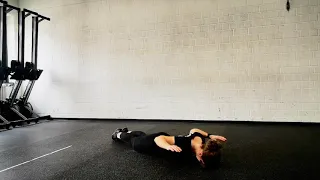
- Lie face down with your legs extended and your forehead facing the floor.
- Extend your arms out to the sides with a slight bend in your elbows.
- Brace your core and keep your chest, hips, and legs in contact with the floor.
- Draw your shoulders away from your ears and lift both arms a few centimeters.
- Gently squeeze your shoulder blades together at the top of the movement.
- Pause briefly, then lower your arms slowly to the starting position.
Technical tips
- Keep the same slight elbow bend throughout each repetition.
- Use a small, controlled range rather than forcing your arms higher.
- Avoid shrugging your shoulders toward your ears.
- Keep your neck neutral and look directly toward the floor.
- Do not lift your chest or excessively arch your lower back.
Breathing tips
- Inhale before beginning each repetition.
- Exhale as you lift your arms and squeeze at the top.
- Inhale slowly as you lower your arms.
- Avoid holding your breath during the exercise.
Medical restrictions
- Acute or unexplained shoulder pain
- Recent shoulder, neck, or upper-back surgery without medical clearance
- Painful shoulder impingement symptoms
- Severe neck or lower-back pain aggravated by lying face down
Description
The Bodyweight Reverse Fly is a floor-based upper-body exercise designed to develop controlled movement around the shoulders and shoulder blades without requiring weights, machines, or resistance bands. It is performed while lying face down and raising the arms away from the floor in a reverse-fly motion. Because the resistance comes primarily from the weight of the arms and gravity, the exercise is accessible to beginners while still demanding precise control.
This movement is particularly useful for improving postural awareness, shoulder-blade coordination, and upper-body stability. It can help counterbalance the large amount of forward-reaching, pressing, computer work, and phone use found in everyday life. Regular practice may also improve control during rowing, pulling, overhead, and pressing exercises by teaching the shoulders to move without excessive shrugging or spinal compensation.
The exercise works well as part of a warm-up, corrective routine, home workout, or low-load strengthening session. Its floor-based setup makes it easy to perform almost anywhere, and the limited external resistance allows users to concentrate on movement quality rather than load. A slow tempo and brief pause at the top can make the exercise considerably more challenging without adding equipment.
The Bodyweight Reverse Fly is also a practical starting point before progressing to band, cable, or dumbbell variations. Although it does not provide the same loading potential as weighted alternatives, it offers an effective way to establish coordination, endurance, and consistent technique before more resistance is introduced.
Frequently asked questions
-
What are the benefits of doing the Bodyweight Reverse Fly?
The Bodyweight Reverse Fly can improve shoulder-blade control, postural awareness, upper-body stability, and movement quality without requiring any equipment. -
What is the most common mistake when I perform a Bodyweight Reverse Fly?
The most common mistake is lifting the arms by shrugging the shoulders or arching the lower back. Keep the shoulders down, the core braced, and the movement slow. -
Is the Bodyweight Reverse Fly safe for my shoulders?
It is generally shoulder-friendly when performed in a comfortable range with controlled movement. Stop if you experience sharp pain, pinching, numbness, or worsening discomfort. -
How is the Bodyweight Reverse Fly different from a dumbbell reverse fly?
The bodyweight version uses less resistance and is easier for learning control and technique. The dumbbell reverse fly offers greater progression potential but requires more load management.
Related fitness articles
See all
Body recomposition: lose fat while building muscle
Muscle gain

Fitness formulas: protein, water, creatine and caffeine
Muscle gain

Carb cycling: useful for losing weight and performing better?
Nutrition

Muscle failure in strength training: what the science says
Muscle gain

Peptides in bodybuilding: effectiveness and risks
Nutrition
Chest pump push-up workout
Muscle gain
Succeeding at your first pull-up
At the gym

Shoulder pain in weight training: prevention and solutions
Risk of injuries
Recommended by our experts
Receive your personalized program
Stop training at random.
Get my program- Program tailored to your profile
- Guided progression
- Compatible with your equipment
- Structured plan
Our coach prepares your program
Get my program