Cross-Body Crunch
Demonstration video
Recommended by our experts
Receive your personalized program
Stop training at random.
Get my program- Program tailored to your profile
- Guided progression
- Compatible with your equipment
- Structured plan
Our coach prepares your program
Get my programHow to do Cross-Body Crunch
Instructions
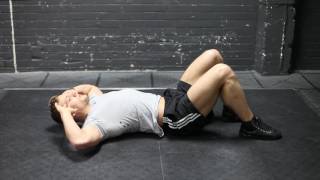
- Lie on your back with your knees bent and both feet on the floor.
- Cross one ankle over the opposite thigh to form a figure-four position.
- Place your fingertips lightly beside your head and keep your elbows open.
- Brace your core and press your lower back gently into the floor.
- Lift your upper back and rotate the opposite shoulder toward the crossed knee.
- Pause briefly at the top without pulling your head forward.
- Lower yourself under control and complete all repetitions before switching sides.
Technical tips
- Initiate the movement by curling and rotating your torso, not by pulling on your neck.
- Keep your lower back in contact with the floor throughout the repetition.
- Focus on bringing your shoulder toward the knee rather than forcing your elbow forward.
- Use a controlled range of motion and avoid using momentum.
- Keep the crossed knee relaxed and pointing outward.
Breathing tips
- Inhale while lowering your upper back toward the floor.
- Exhale as you curl and rotate toward the crossed knee.
- Avoid holding your breath during the contraction.
Medical restrictions
- Acute neck or lower-back pain
- Recent abdominal surgery or an unresolved abdominal hernia
- Severe hip or knee pain in the figure-four position
- Pregnancy when supine exercise has been medically restricted
Description
The Cross-Body Crunch is a floor-based core exercise that combines spinal flexion with controlled torso rotation. Unlike a standard straight-ahead crunch, the diagonal movement challenges the body to coordinate rotation while keeping the pelvis stable. This makes the exercise particularly useful for developing stronger rotational control, improving trunk coordination, and building the stability needed for everyday movements and athletic activities.
The figure-four leg position creates a clear target for each repetition and helps users focus on bringing the opposite shoulder toward the raised knee. Because each side is trained separately, the exercise can also help reveal differences in control, strength, or coordination between the left and right sides of the body. Its simple setup makes it suitable for home workouts, gym sessions, circuit training, and short core-focused routines.
Cross-Body Crunches can support better body awareness by teaching the upper torso to move independently while the lower body remains relatively still. The controlled diagonal pattern may also transfer well to activities involving turning, reaching, running, or changing direction. Since no external resistance is required, the exercise is easy to include in beginner programs while still offering value to more experienced trainees when performed slowly and with strict control. Repetition quality is more important than achieving a large range of motion, making the Cross-Body Crunch an accessible and practical option for focused core training.
Frequently asked questions
-
What are the benefits of Cross-Body Crunches?
Cross-Body Crunches improve rotational core strength, trunk coordination, side-to-side control, and body awareness without requiring any equipment. -
What is the most common mistake during Cross-Body Crunches?
The most common mistake is pulling the head forward with the hands. Keep your fingertips light and rotate by bringing the shoulder toward the opposite knee. -
Are Cross-Body Crunches safe for my lower back?
They are generally safe when performed with a controlled range of motion and the lower back kept gently against the floor. Stop if you feel sharp or increasing back pain. -
How are Cross-Body Crunches different from standard crunches?
Standard crunches primarily use a straight curling motion, while Cross-Body Crunches add torso rotation and train one side at a time, requiring greater rotational control. -
How many Cross-Body Crunches should I do?
Begin with 8 to 15 controlled repetitions per side for 2 to 3 sets. Increase repetitions only when you can maintain strict technique without momentum.
Variants and alternatives
See all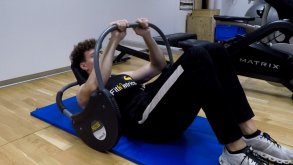
Ab crunch
Beginner
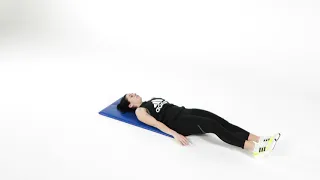
Cocoons
Beginner
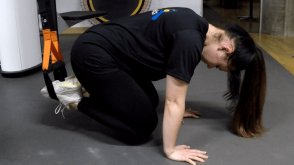
Trx abdominal crunch
Intermediate
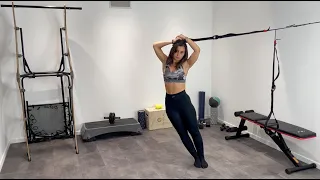
Trx oblique crunch
Intermediate
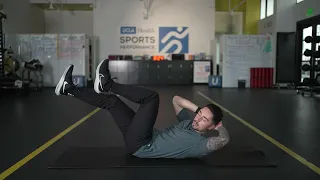
Bicycle crunches
Intermediate
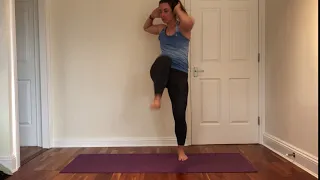
Standing cross crunch
Beginner
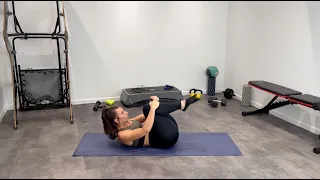
Tuck crunch
Beginner
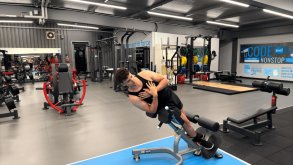
Incline side crunch
Beginner
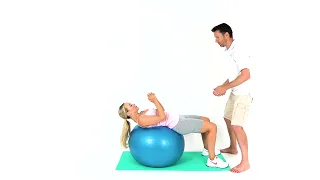
Stability ball overhead catch and throw crunch
Intermediate
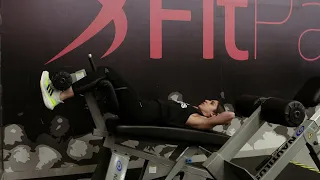
Decline crunch
Intermediate
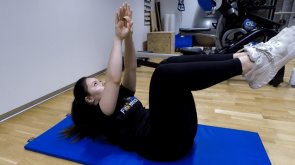
Legs raised crunch
Beginner

Standing oblique crunch
Beginner
Related fitness articles
See all
Body recomposition: lose fat while building muscle
Muscle gain

Fitness formulas: protein, water, creatine and caffeine
Muscle gain

Carb cycling: useful for losing weight and performing better?
Nutrition

Muscle failure in strength training: what the science says
Muscle gain

Peptides in bodybuilding: effectiveness and risks
Nutrition
Chest pump push-up workout
Muscle gain
Succeeding at your first pull-up
At the gym

Shoulder pain in weight training: prevention and solutions
Risk of injuries
Recommended by our experts
Receive your personalized program
Stop training at random.
Get my program- Program tailored to your profile
- Guided progression
- Compatible with your equipment
- Structured plan
Our coach prepares your program
Get my program