Leg Tuck and Twist
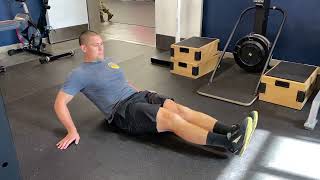
Demonstration video
Recommended by our experts
Receive your personalized program
Stop training at random.
Get my program- Program tailored to your profile
- Guided progression
- Compatible with your equipment
- Structured plan
Our coach prepares your program
Get my programHow to do Leg Tuck and Twist
Instructions
- Sit on the floor with your hands placed behind you for support.
- Lean your torso slightly back and lift your feet off the floor.
- Keep your knees bent and your core braced.
- Tuck your knees toward your chest while rotating them slightly to one side.
- Extend your legs forward under control, then repeat the tuck and twist to the opposite side.
- Continue alternating sides with smooth, controlled repetitions.
Technical tips
- Keep your chest lifted and avoid rounding your lower back excessively.
- Move from your trunk and hips instead of swinging your legs.
- Keep your hands lightly on the floor for balance, not to push the movement.
- Control the extension phase to keep constant tension through your core.
- Use a smaller range of motion if your lower back starts to arch or strain.
Breathing tips
- Exhale as you tuck your knees and rotate.
- Inhale as you extend your legs forward.
- Keep your breathing steady and avoid holding your breath.
- Brace your core gently before each repetition.
Medical restrictions
- Avoid this exercise if you have acute lower back pain or a recent lumbar spine injury.
- Use caution if you have hip flexor irritation or pain during seated leg raises.
- Avoid aggressive twisting if you have a recent abdominal strain or hernia.
- Stop the exercise if you feel sharp pain, numbness, or radiating discomfort.
Description
The Leg Tuck and Twist is a dynamic bodyweight core exercise that combines a seated knee tuck with controlled trunk rotation. It is designed to build stronger midsection control, improve rotational stability, and challenge coordination without requiring any equipment. Because the movement blends leg extension, knee drive, balance, and twisting, it is especially useful for people who want a more athletic alternative to basic crunches.
This exercise is commonly used in fitness, calisthenics, Pilates-inspired core training, and functional workouts. It helps develop the ability to stabilize the torso while the legs move, which can carry over to sports, bodyweight training, and everyday movement. The alternating twist also adds a rotational component, making the exercise more complete than a simple seated tuck.
The Leg Tuck and Twist works well in core circuits, home workouts, conditioning sessions, or as an accessory movement after strength training. It can be performed for repetitions or included in timed intervals depending on the goal. Beginners can keep the feet closer to the floor or reduce the twist, while more advanced users can slow the tempo, increase the range of motion, or perform longer sets for greater muscular endurance.
Frequently asked questions
-
What are the benefits of doing the Leg Tuck and Twist?
The Leg Tuck and Twist improves core strength, rotational control, balance, and muscular endurance. It is a useful no-equipment exercise for building a stronger and more stable midsection. -
What muscles does the Leg Tuck and Twist target?
The Leg Tuck and Twist mainly targets the abs, with strong involvement from the obliques, lower back stabilizers, and hip flexion muscles during the tuck and extension. -
What is the most common mistake in the Leg Tuck and Twist?
The most common mistake is swinging the legs instead of controlling the movement. Keep the core braced, move slowly, and avoid collapsing the chest or rounding the lower back. -
Is the Leg Tuck and Twist safe for my lower back?
It can be safe when performed with control and a neutral, supported posture. If your lower back arches, strains, or feels painful, reduce the range of motion or choose an easier core exercise. -
Is the Leg Tuck and Twist better than a regular seated knee tuck?
The Leg Tuck and Twist adds rotation, making it more challenging for core control and oblique engagement. A regular seated knee tuck is simpler and usually better for beginners. -
How many reps of the Leg Tuck and Twist should I do?
Start with 8 to 15 controlled reps per set. Focus on clean technique first, then increase volume or slow the tempo as your core strength improves.
Variants and alternatives
See all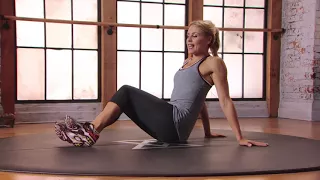
Related fitness articles
See all
Body recomposition: lose fat while building muscle
Muscle gain

Fitness formulas: protein, water, creatine and caffeine
Muscle gain

Carb cycling: useful for losing weight and performing better?
Nutrition

Muscle failure in strength training: what the science says
Muscle gain

Peptides in bodybuilding: effectiveness and risks
Nutrition
Chest pump push-up workout
Muscle gain
Succeeding at your first pull-up
At the gym

Shoulder pain in weight training: prevention and solutions
Risk of injuries
Recommended by our experts
Receive your personalized program
Stop training at random.
Get my program- Program tailored to your profile
- Guided progression
- Compatible with your equipment
- Structured plan
Our coach prepares your program
Get my program