Band Glute Kickback
Demonstration video

Recommended by our experts
Receive your personalized program
Stop training at random.
Get my program- Program tailored to your profile
- Guided progression
- Compatible with your equipment
- Structured plan
Our coach prepares your program
Get my programHow to do Band Glute Kickback
Instructions
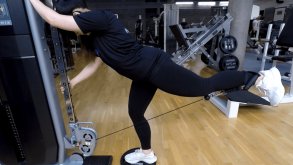
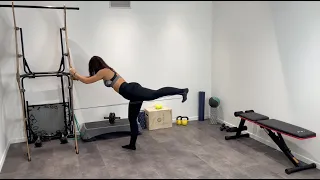
- Place a resistance band around your foot and secure the other end under your hands in a quadruped position.
- Keep your core engaged and your back flat.
- Extend one leg upward and backward in a controlled motion.
- Pause briefly at the top of the movement.
- Return slowly to the starting position and repeat.
Technical Tips
- Avoid arching your lower back during the movement.
- Focus on squeezing the glutes at the top of the extension.
- Keep your hips square and stable throughout the exercise.
Breathing Tips
- Exhale as you kick your leg back.
- Inhale as you return to the starting position.
Medical restrictions
- Lower back injuries
- Hip joint pathologies
- Knee instability or recent knee surgery
Description
The Band Glute Kickback on the Floor is an effective isolation exercise designed to target and strengthen the gluteal muscles, particularly the gluteus maximus. This bodyweight-friendly movement utilizes an elastic resistance band to increase load on the working leg, making it ideal for home workouts or lower body activation circuits. Performed on the floor in a quadruped position, it engages the hips and core to stabilize the movement while encouraging full hip extension. This exercise is commonly used to enhance glute hypertrophy, improve hip mobility, and activate posterior chain muscles before compound lifts. Because of its simplicity and effectiveness, the Band Glute Kickback is suitable for all fitness levels, especially beginners looking to build a solid glute foundation without complex equipment. Whether integrated into a glute-focused workout or used for pre-activation in strength training, this movement offers a reliable way to develop stronger, more defined glutes. Additionally, its unilateral nature helps correct muscular imbalances and improve neuromuscular coordination.
Frequently asked questions
-
How do I perform a band glute kickback correctly?
To perform a band glute kickback correctly, start in a quadruped position with a resistance band secured under your hands and foot. Extend your leg upward and backward while keeping your core tight and hips stable. Squeeze your glutes at the top and return slowly. -
What muscles do band glute kickbacks target?
Band glute kickbacks primarily target the glutes, especially the gluteus maximus. They also engage the gluteus medius, hip abductors, lower back, and core stabilizers for control and support. -
Are band glute kickbacks effective for building glutes?
Yes, band glute kickbacks are highly effective for building glutes. They provide targeted resistance, promote muscle activation, and help improve shape and strength in the gluteal region. -
Can beginners do band glute kickbacks?
Yes, band glute kickbacks are beginner-friendly. They require minimal equipment, are easy to learn, and offer a safe way to strengthen the glutes with controlled movements. -
How many reps of band glute kickbacks should I do?
For general glute activation or hypertrophy, aim for 10–15 reps per leg for 2–4 sets. Adjust based on your fitness level and resistance band strength.
Related fitness articles
See all
Body recomposition: lose fat while building muscle
Muscle gain

Fitness formulas: protein, water, creatine and caffeine
Muscle gain

Carb cycling: useful for losing weight and performing better?
Nutrition

Muscle failure in strength training: what the science says
Muscle gain

Peptides in bodybuilding: effectiveness and risks
Nutrition
Chest pump push-up workout
Muscle gain
Succeeding at your first pull-up
At the gym

Shoulder pain in weight training: prevention and solutions
Risk of injuries
Recommended by our experts
Receive your personalized program
Stop training at random.
Get my program- Program tailored to your profile
- Guided progression
- Compatible with your equipment
- Structured plan
Our coach prepares your program
Get my program