Banded Plank
Demonstration video
Recommended by our experts
Receive your personalized program
Stop training at random.
Get my program- Program tailored to your profile
- Guided progression
- Compatible with your equipment
- Structured plan
Our coach prepares your program
Get my programHow to do Banded Plank
Instructions
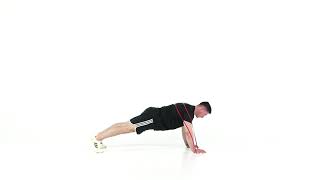
- Place a resistance band around your upper back and secure it under your palms.
- Get into a forearm or high plank position with arms fully extended and feet hip-width apart.
- Keep your body in a straight line from head to heels.
- Engage your core and maintain tension in the band throughout the hold.
- Hold the position for the prescribed duration without letting your hips sag.
Technical Tips
- Ensure your shoulders are stacked over your wrists.
- Avoid arching your lower back or lifting your hips too high.
- Maintain active engagement in your glutes and quadriceps.
- Distribute your weight evenly through your palms and toes.
Breathing Tips
- Inhale deeply through the nose before initiating the hold.
- Exhale slowly and consistently through the mouth during the hold.
- Avoid holding your breath to maintain core stability and oxygen flow.
Medical restrictions
- Lower back pain or spinal instability
- Shoulder impingement or rotator cuff injury
- Wrist injuries or carpal tunnel syndrome
Description
The banded plank is an advanced core stability exercise that incorporates resistance to intensify muscle activation. By integrating an elastic band into the traditional plank setup, this variation challenges the deep stabilizers of the core, particularly the transverse abdominis, while enhancing shoulder and upper back engagement. Ideal for individuals looking to progress beyond bodyweight planks, the added tension requires continuous core bracing and full-body alignment. This movement not only strengthens the abdominal region but also improves postural control, joint stability, and neuromuscular coordination. The banded plank is frequently used in functional training routines, athletic conditioning programs, and calisthenics as a dynamic isometric tool. Its versatility and effectiveness make it a valuable inclusion in intermediate to advanced training plans targeting core resilience and performance efficiency.
Frequently asked questions
-
What muscles does the banded plank work the most?
The banded plank primarily targets the abdominal muscles, especially the transverse abdominis, and secondarily engages the shoulders, triceps, lower back, and quadriceps. -
Is a banded plank better than a regular plank?
Yes, a banded plank adds external resistance, increasing core and shoulder activation, making it more challenging and effective for muscle development and stability. -
Can beginners do the banded plank?
The banded plank is best suited for intermediate users; beginners should master the standard plank first to build foundational core strength. -
How long should I hold a banded plank?
Start with 20 to 30 seconds and gradually increase duration as your core strength and endurance improve. -
What type of resistance band is best for the banded plank?
Flat loop resistance bands are ideal for banded planks as they provide stable and evenly distributed tension across the back and arms.
Variants and alternatives
See all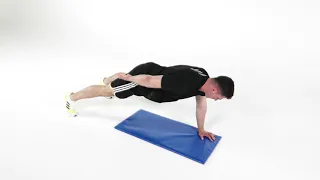
One arm plank
Advanced
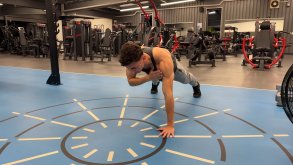
Plank shoulder tap
Intermediate
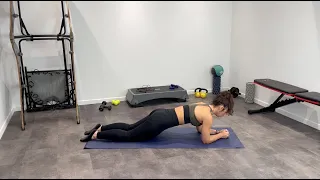
Plank on knees
Beginner
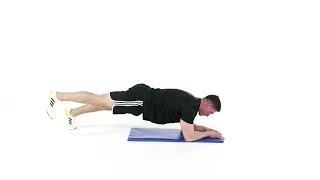
One-leg plank
Intermediate
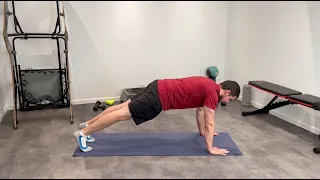
Planks on hands
Beginner
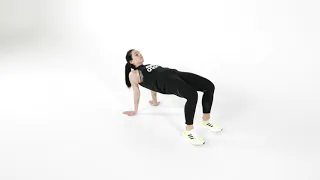
Reverse plank
Intermediate
Side plank
Intermediate
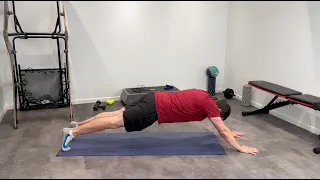
Outstretched arms plank
Intermediate
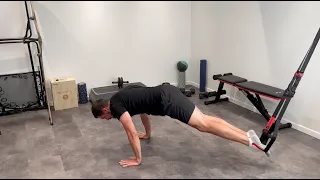
Trx pendulum swing
Intermediate
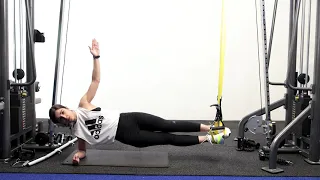
Trx side plank
Advanced
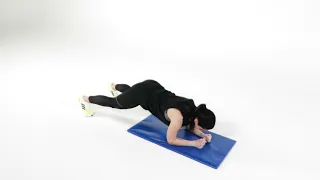
Commando plank
Intermediate

Side plank on knees
Beginner
Related fitness articles
See all
Body recomposition: lose fat while building muscle
Muscle gain

Fitness formulas: protein, water, creatine and caffeine
Muscle gain

Carb cycling: useful for losing weight and performing better?
Nutrition

Muscle failure in strength training: what the science says
Muscle gain

Peptides in bodybuilding: effectiveness and risks
Nutrition
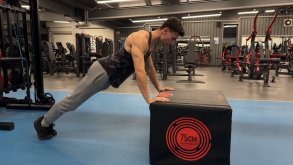
Chest pump push-up workout
Muscle gain
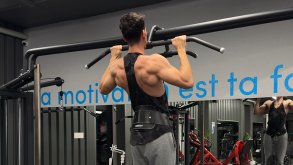
Succeeding at your first pull-up
At the gym

Shoulder pain in weight training: prevention and solutions
Risk of injuries
Recommended by our experts
Receive your personalized program
Stop training at random.
Get my program- Program tailored to your profile
- Guided progression
- Compatible with your equipment
- Structured plan
Our coach prepares your program
Get my program