L-Sit Rope Climb
Demonstration video

Recommended by our experts
Receive your personalized program
Stop training at random.
Get my program- Program tailored to your profile
- Guided progression
- Compatible with your equipment
- Structured plan
Our coach prepares your program
Get my programHow to do L-Sit Rope Climb
Instructions
- Start in a hanging position on the rope with legs extended straight in front of you to form an L-sit.
- Engage your core to maintain the L-sit position and keep your legs horizontal throughout the movement.
- Pull yourself upward hand-over-hand, keeping the rope close to your body.
- Do not allow your legs to drop below the horizontal plane.
- Climb to the desired height and descend with control, maintaining the L-sit as long as possible.
Technical Tips
- Maintain a tight L-sit to ensure constant core engagement.
- Use slow, controlled pulls to prevent swinging or leg drop.
- Keep your arms and lats engaged for efficient climbing and stability.
Breathing Tips
- Inhale before initiating each pull.
- Exhale slowly during the pulling motion while maintaining core tension.
- Use controlled breathing to manage fatigue and maintain posture.
Medical restrictions
- Lower back pain or disc issues
- Shoulder impingement or instability
- Elbow or wrist tendinitis
- Hamstring tightness or hip flexor strain
Description
The L-Sit Rope Climb is a demanding full-body exercise that merges the benefits of rope climbing with the core-intensive L-sit position. This advanced variation requires you to maintain a strict L-sit—legs extended parallel to the floor—throughout the climb. This position drastically increases abdominal and hip flexor engagement while maintaining the traditional demands on upper-body pulling strength and grip endurance. The L-Sit Rope Climb challenges coordination, body control, and muscular endurance, making it a staple in high-level calisthenics and functional fitness programs. It reinforces strict movement patterns, enhances scapular stability, and improves total-body tension control. Athletes benefit from improved midline stability, pulling strength, and positional awareness, while also increasing resistance to fatigue in the core and arms. Due to its complexity, this exercise is best suited for individuals who have mastered basic rope climbs and L-sit holds independently.
Frequently asked questions
-
What is the L-Sit Rope Climb good for?
The L-Sit Rope Climb is excellent for building core strength, upper-body pulling power, and full-body control under tension. -
Do I need to master the L-sit before attempting this exercise?
Yes, having a strong L-sit and basic rope climbing ability is essential before progressing to this advanced variation. -
Which muscles are worked during the L-Sit Rope Climb?
It targets the abs, biceps, and back, while also engaging the hip flexors, forearms, traps, and shoulders. -
How do I keep my legs up during the climb?
Engage your core and hip flexors fully, and keep your legs locked straight while climbing with controlled upper-body pulls. -
Is the L-Sit Rope Climb good for functional training?
Yes, it enhances functional strength by combining isometric core work with dynamic pulling, improving real-world coordination and control.
Variants and alternatives
See all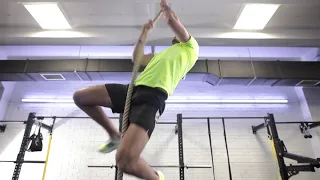
Related fitness articles
See all
Body recomposition: lose fat while building muscle
Muscle gain

Fitness formulas: protein, water, creatine and caffeine
Muscle gain

Carb cycling: useful for losing weight and performing better?
Nutrition

Muscle failure in strength training: what the science says
Muscle gain

Peptides in bodybuilding: effectiveness and risks
Nutrition

Chest pump push-up workout
Muscle gain

Succeeding at your first pull-up
At the gym

Shoulder pain in weight training: prevention and solutions
Risk of injuries
Recommended by our experts
Receive your personalized program
Stop training at random.
Get my program- Program tailored to your profile
- Guided progression
- Compatible with your equipment
- Structured plan
Our coach prepares your program
Get my program