Single-Leg Leg Press
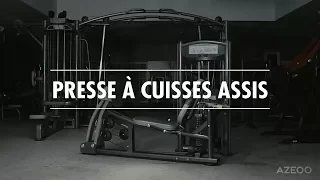
Demonstration video

Recommended by our experts
Receive your personalized program
Stop training at random.
Get my program- Program tailored to your profile
- Guided progression
- Compatible with your equipment
- Structured plan
Our coach prepares your program
Get my programHow to do Single-Leg Leg Press
Instructions
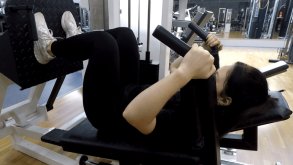
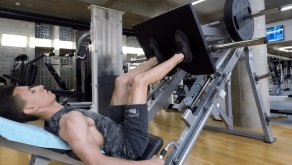
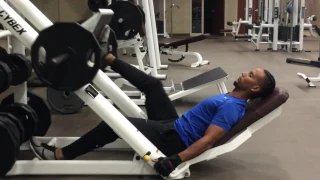
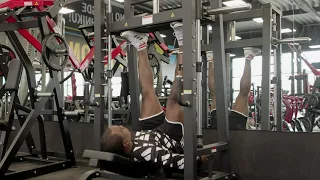
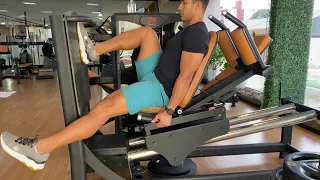
- Sit on the leg press machine with one foot placed in the center of the platform.
- Keep the opposite foot off the platform and hold the handles for stability.
- Lower the platform slowly by bending the working leg until the knee reaches about 90 degrees.
- Press through the heel to extend the leg without locking the knee.
- Complete all repetitions on one side before switching legs.
Technical tips
- Keep your lower back flat against the seat throughout the movement.
- Align your knee with your toes during both lowering and pressing phases.
- Use controlled tempo and avoid bouncing at the bottom position.
- Do not fully lock out the knee at the top of the movement.
- Start with lighter loads to maintain balance and stability.
Breathing tips
- Inhale while lowering the platform.
- Exhale while pressing the platform away.
- Maintain steady breathing and avoid holding your breath during repetitions.
Medical restrictions
- Knee ligament injuries or severe knee pain
- Recent hip surgery or hip instability
- Lower back injuries aggravated by loaded leg movements
- Severe ankle mobility limitations
- Post-operative lower body rehabilitation without medical clearance
Description
The Single-Leg Leg Press is a unilateral lower-body strength exercise performed on a guided machine that allows each leg to work independently. This movement is widely used in bodybuilding, fitness, and athletic strength programs to improve lower-body strength, muscular balance, and movement efficiency. By training one leg at a time, the exercise helps identify and correct left-to-right strength imbalances that may affect overall performance or movement quality.
Compared to bilateral leg press variations, the unilateral version increases focus on stability, coordination, and controlled force production while reducing compensation from the stronger side. It also allows lifters to achieve a high level of muscular effort using moderate loads, making it useful for hypertrophy-focused training and controlled strength development.
The guided machine setup provides additional support and balance compared to free-weight unilateral exercises, making it more accessible for intermediate lifters or individuals transitioning toward single-leg strength work. The movement pattern closely mimics lower-body pushing mechanics used in sports and daily activities such as climbing stairs, sprinting, and changing direction.
The Single-Leg Leg Press is commonly programmed in lower-body workouts to enhance symmetry, improve training efficiency, and increase unilateral leg strength while maintaining a stable and controlled training environment.
Frequently asked questions
-
What are the benefits of doing the Single-Leg Leg Press?
The Single-Leg Leg Press helps improve unilateral leg strength, muscular symmetry, balance, and lower-body control while reducing strength imbalances between sides. -
Is the Single-Leg Leg Press better than the regular Leg Press?
The Single-Leg Leg Press is better for correcting muscle imbalances and improving single-leg stability, while the regular Leg Press is more suitable for lifting heavier total loads. -
What is the most common mistake during the Single-Leg Leg Press?
The most common mistake is allowing the knee to collapse inward during the movement, which can reduce stability and increase joint stress. -
Is the Single-Leg Leg Press safe for my knees?
The exercise can be knee-friendly when performed with controlled range of motion, proper knee alignment, and moderate loads. Avoid excessive depth if you experience knee discomfort. -
How many reps should I do for the Single-Leg Leg Press?
Most people perform 8 to 15 repetitions per leg depending on whether the goal is strength, muscle growth, or muscular endurance. -
Does the Single-Leg Leg Press help with muscle imbalances?
Yes, unilateral training forces each leg to work independently, making the Single-Leg Leg Press highly effective for correcting strength and coordination asymmetries.

Related fitness articles
See all
Body recomposition: lose fat while building muscle
Muscle gain

Fitness formulas: protein, water, creatine and caffeine
Muscle gain

Carb cycling: useful for losing weight and performing better?
Nutrition
Muscle failure in strength training: what the science says
Muscle gain

Peptides in bodybuilding: effectiveness and risks
Nutrition
Chest pump push-up workout
Muscle gain
Succeeding at your first pull-up
At the gym

Shoulder pain in weight training: prevention and solutions
Risk of injuries
Recommended by our experts
Receive your personalized program
Stop training at random.
Get my program- Program tailored to your profile
- Guided progression
- Compatible with your equipment
- Structured plan
Our coach prepares your program
Get my program