Jumping Spiderman Mountain Climber
Demonstration video

Recommended by our experts
Receive your personalized program
Stop training at random.
Get my program- Program tailored to your profile
- Guided progression
- Compatible with your equipment
- Structured plan
Our coach prepares your program
Get my programHow to do Jumping Spiderman Mountain Climber
Instructions
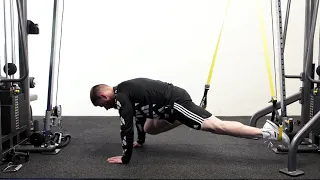
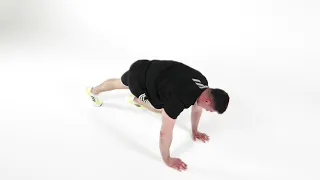
- Start in a high plank with your hands under your shoulders and your body in a straight line.
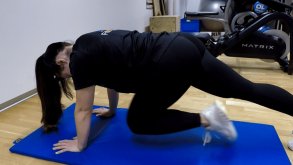
- Brace your core and jump your right foot forward, landing it outside your right hand.
- Keep your left leg extended behind you and land softly with your hips low.
- Push through your hands and feet, then jump to switch legs.
- Land your left foot outside your left hand while extending your right leg back.
- Continue alternating sides in a controlled rhythm, counting each side as one repetition.
Technical tips
- Keep your shoulders stacked over your wrists throughout the movement.
- Land your front foot beside your hand without letting the heel or toes strike the hand.
- Keep your hips relatively low and avoid excessive bouncing.
- Use a quick, compact jump rather than an unnecessarily high leap.
- Maintain a neutral spine and keep your abdominal area braced.
- Prioritize accurate foot placement before increasing speed.
Breathing tips
- Inhale in the plank position before beginning the first switch.
- Exhale as you jump and drive one foot forward.
- Continue using short, rhythmic breaths as you alternate sides.
- Avoid holding your breath during fast repetitions.
Medical restrictions
- Acute wrist pain or wrist injury
- Shoulder instability or acute shoulder pain
- Acute lower-back pain
- Hip impingement or painful hip flexion
- Recent knee or ankle injury
- Uncontrolled cardiovascular disease or medical exercise restrictions
Description
The Jumping Spiderman Mountain Climber is an explosive conditioning exercise that combines a high-plank pattern with rapid, alternating lateral foot placements. Unlike the regular Spiderman Mountain Climber, every transition includes a brief airborne switch, increasing the pace and overall training demand. The exercise is designed to develop cardiovascular fitness, explosive endurance, coordination, agility, and the ability to repeat powerful movements while fatigued.
Its alternating rhythm challenges timing and body control as you move quickly from one side to the other. The wider foot path also creates a more complex movement pattern than a standard mountain climber, helping improve dynamic balance and spatial awareness. Because each repetition requires a fast transition followed by an accurate landing, the exercise can support better movement efficiency during athletic tasks involving quick changes of position.
Jumping Spiderman Mountain Climbers work particularly well in interval training, metabolic circuits, athletic conditioning sessions, and short, high-intensity workouts. They provide a substantial conditioning stimulus within a limited training window and can raise heart rate quickly without requiring a complicated setup. The pace can be adjusted to emphasize precision, rhythm, or maximal intensity, making the movement adaptable within advanced conditioning programs.
Consistent practice can improve work capacity and help maintain coordination as fatigue builds. Compared with slower plank-based drills, this jumping variation places greater emphasis on speed, reactivity, and repeated power. When performed with controlled transitions and consistent landings, it is an effective choice for building high-intensity fitness and more athletic movement quality.
Frequently asked questions
-
What benefits will I get from Jumping Spiderman Mountain Climbers?
Jumping Spiderman Mountain Climbers improve cardiovascular fitness, explosive endurance, coordination, agility, dynamic balance, and whole-body work capacity. -
What is the most common mistake I should avoid?
The most common mistake is jumping too quickly and losing plank alignment. Keep your shoulders over your wrists, your core braced, and your landings controlled. -
How can I perform Jumping Spiderman Mountain Climbers safely?
Land softly, keep your hands firmly planted, avoid excessive hip rotation, and stop if you feel sharp pain in your wrists, shoulders, back, hips, knees, or ankles. -
Why should I choose the jumping version over the regular Spiderman Mountain Climber?
The jumping variation produces a greater cardiovascular and plyometric demand, while the regular version offers more control and is better for learning the movement pattern. -
How many Jumping Spiderman Mountain Climbers should I perform?
Begin with 6 to 10 repetitions per side for 2 to 3 sets. Increase the repetitions only when you can maintain accurate foot placement and stable posture.

Related fitness articles
See all
Body recomposition: lose fat while building muscle
Muscle gain

Fitness formulas: protein, water, creatine and caffeine
Muscle gain

Carb cycling: useful for losing weight and performing better?
Nutrition

Muscle failure in strength training: what the science says
Muscle gain

Peptides in bodybuilding: effectiveness and risks
Nutrition
Chest pump push-up workout
Muscle gain

Succeeding at your first pull-up
At the gym

Shoulder pain in weight training: prevention and solutions
Risk of injuries
Recommended by our experts
Receive your personalized program
Stop training at random.
Get my program- Program tailored to your profile
- Guided progression
- Compatible with your equipment
- Structured plan
Our coach prepares your program
Get my program