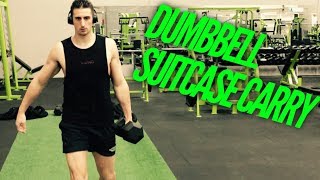
Dumbbell Suitcase Carry
Demonstration video
Recommended by our experts
Receive your personalized program
Stop training at random.
Get my program- Program tailored to your profile
- Guided progression
- Compatible with your equipment
- Structured plan
Our coach prepares your program
Get my programHow to do Dumbbell Suitcase Carry
Instructions
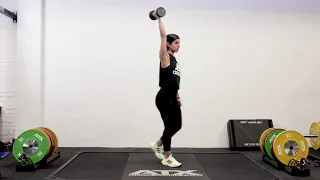
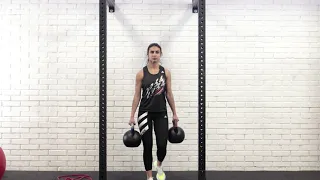
- Stand tall with one dumbbell on the floor beside your foot.
- Hinge slightly at the hips, grip the dumbbell, and stand up with a neutral spine.
- Let the dumbbell hang at your side with your arm straight.
- Brace your core and keep your shoulders level.
- Walk forward with controlled steps for the prescribed time or distance.
- Turn carefully if needed, then repeat on the opposite side.
Technical tips
- Do not lean toward or away from the dumbbell.
- Keep your ribs stacked over your pelvis.
- Walk slowly enough to control your posture.
- Keep your shoulder pulled slightly down and back.
- Avoid shrugging, twisting, or swinging the dumbbell.
Breathing tips
- Inhale before you start walking and brace your midsection.
- Use short, controlled breaths while maintaining core tension.
- Exhale slowly without losing posture or letting the torso tilt.
Medical restrictions
- Avoid this exercise during acute low back pain or disc irritation.
- Use caution with uncontrolled balance disorders or dizziness.
- Avoid heavy loading with active shoulder, elbow, wrist, or grip injuries.
- Stop if you feel sharp pain, numbness, or radiating symptoms.
Description
The dumbbell suitcase carry is a practical loaded carry exercise performed by walking while holding one dumbbell at your side, similar to carrying a heavy suitcase. It is highly effective for building real-world strength, posture control, and total-body coordination because the uneven load challenges the body to stay upright and stable while moving. Unlike many traditional gym exercises performed in a fixed position, this movement trains strength that transfers directly to daily tasks such as carrying groceries, luggage, tools, or heavy bags.
This exercise is especially valuable because it combines strength, stability, and movement quality in one simple drill. The single-sided load forces the body to resist leaning or rotating, making it an excellent choice for improving trunk control and overall athletic balance. It also develops grip endurance, shoulder positioning, and walking mechanics under load.
The dumbbell suitcase carry can fit well into strength training, functional fitness, conditioning circuits, warm-ups, or core-focused sessions. It is easy to scale by changing the dumbbell weight, walking distance, duration, or speed. Beginners can start light and focus on posture, while more advanced users can increase load or carry time for a greater challenge. When performed with control, it is a simple but powerful exercise for building durable, usable strength.
Frequently asked questions
-
What are the benefits of doing the dumbbell suitcase carry?
The dumbbell suitcase carry improves functional strength, posture control, grip endurance, core stability, and loaded walking ability. It is useful for both gym performance and everyday carrying tasks. -
What muscles does the dumbbell suitcase carry work?
The dumbbell suitcase carry mainly trains the core, forearms, and upper traps, while also engaging the lower back, glutes, legs, and shoulder stabilizers to maintain posture while walking. -
What is the most common mistake in the dumbbell suitcase carry?
The most common mistake is leaning to one side instead of staying upright. Keep your shoulders level, brace your core, and walk with controlled steps. -
Is the dumbbell suitcase carry safe for my lower back?
It can be safe when performed with a neutral spine, controlled load, and proper bracing. Avoid going too heavy if you cannot prevent leaning, twisting, or back discomfort. -
How heavy should my dumbbell be for suitcase carries?
Choose a dumbbell that challenges your grip and posture without forcing you to lean or lose control. Start light, then increase the load gradually as your stability improves. -
How long should I perform the dumbbell suitcase carry?
A common starting point is 20 to 40 seconds per side. You can also use distance-based targets, such as 10 to 30 meters per side, depending on space and training goals. -
How is the dumbbell suitcase carry different from a farmer carry?
The dumbbell suitcase carry uses one weight on one side, creating a stronger anti-leaning core challenge. A farmer carry uses two weights and usually allows heavier total loading.
Related fitness articles
See all
Body recomposition: lose fat while building muscle
Muscle gain

Fitness formulas: protein, water, creatine and caffeine
Muscle gain

Carb cycling: useful for losing weight and performing better?
Nutrition

Muscle failure in strength training: what the science says
Muscle gain

Peptides in bodybuilding: effectiveness and risks
Nutrition
Chest pump push-up workout
Muscle gain
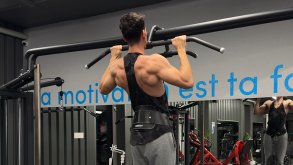
Succeeding at your first pull-up
At the gym

Shoulder pain in weight training: prevention and solutions
Risk of injuries
Recommended by our experts
Receive your personalized program
Stop training at random.
Get my program- Program tailored to your profile
- Guided progression
- Compatible with your equipment
- Structured plan
Our coach prepares your program
Get my program