Semi-Tandem Balance Hold
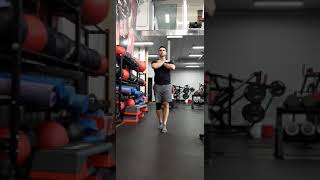
Demonstration video
Recommended by our experts
Receive your personalized program
Stop training at random.
Get my program- Program tailored to your profile
- Guided progression
- Compatible with your equipment
- Structured plan
Our coach prepares your program
Get my programHow to do Semi-Tandem Balance Hold
Instructions
- Stand upright with one foot slightly in front of the other so the heel of the front foot is aligned with the big toe of the back foot.
- Cross your arms over your chest and find a steady posture.
- Once stable, gently close your eyes and hold the position.
- Keep your body tall and still while maintaining balance.
- Repeat with the opposite foot in front.
Technical tips
- Keep most of your weight centered between both feet.
- Brace your trunk lightly and avoid leaning side to side.
- Keep your gaze level before closing your eyes.
- Use slow, controlled corrections instead of sudden movements.
- Stand near a wall or sturdy support if needed for safety.
Breathing tips
- Breathe slowly and naturally throughout the hold.
- Avoid holding your breath when you feel unstable.
- Use calm nasal breathing to help stay relaxed and steady.
Medical restrictions
- Severe dizziness or vertigo
- Recent ankle, knee, or hip injury
- Uncontrolled neurological balance disorders
- High fall risk without supervision
- Recent concussion or acute inner ear issues
Description
The Semi-Tandem Stance is a simple yet highly effective balance exercise used to improve postural control, coordination, and body awareness. In this variation, crossing the arms over the chest and closing the eyes makes the drill more challenging by reducing the help normally provided by arm position and visual input. This forces the body to rely more on internal balance mechanisms, making it especially useful for improving stability in everyday movement.
This exercise is often used in fitness, rehabilitation, fall-prevention routines, and functional training because it is accessible, requires no equipment, and can be performed almost anywhere. Practicing the Semi-Tandem Stance can help develop better control while standing, turning, walking, and changing direction. It is also a valuable drill for people who want to improve coordination, refine posture, and enhance confidence during single-support and narrow-base positions.
Because it is low impact and easy to scale, the Semi-Tandem Stance fits well into warm-ups, balance circuits, and daily movement practice. It can be used by beginners learning basic stability or by more advanced users looking to challenge proprioception and focus. Over time, consistent practice can improve steadiness, movement efficiency, and overall balance performance in sport, exercise, and daily life.
Frequently asked questions
-
What are the benefits of doing the semi-tandem stance?
The semi-tandem stance helps improve balance, postural control, coordination, and body awareness. It is especially useful for functional fitness, fall-prevention work, and building confidence in standing stability. -
What is the most common mistake in the semi-tandem stance?
The most common mistake is shifting too much weight onto one foot or leaning the trunk side to side. A tall posture with controlled weight distribution usually makes the exercise more effective. -
Is the semi-tandem stance safe if I have poor balance?
Yes, but it should be modified. Start with your eyes open and stand near a wall, countertop, or sturdy support so you can catch yourself if needed. -
Should I do the semi-tandem stance with my eyes closed or open?
Most people should first master the semi-tandem stance with eyes open. Closing the eyes increases the difficulty and is better used once you can hold the position safely with control. -
How long should I hold a semi-tandem stance?
A common starting point is 10 to 30 seconds per side. As your balance improves, you can gradually increase the hold time or add more challenging variations.
Variants and alternatives
See all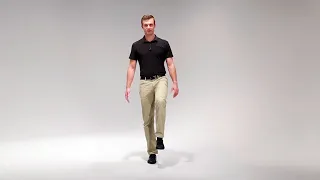
Related fitness articles
See all
Body recomposition: lose fat while building muscle
Muscle gain

Fitness formulas: protein, water, creatine and caffeine
Muscle gain

Carb cycling: useful for losing weight and performing better?
Nutrition

Muscle failure in strength training: what the science says
Muscle gain

Peptides in bodybuilding: effectiveness and risks
Nutrition
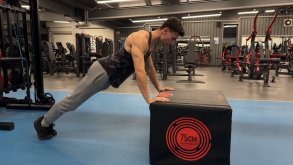
Chest pump push-up workout
Muscle gain
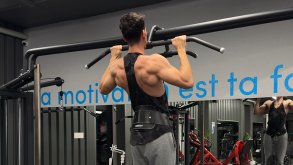
Succeeding at your first pull-up
At the gym

Shoulder pain in weight training: prevention and solutions
Risk of injuries
Recommended by our experts
Receive your personalized program
Stop training at random.
Get my program- Program tailored to your profile
- Guided progression
- Compatible with your equipment
- Structured plan
Our coach prepares your program
Get my program