Dumbbell Sumo Deadlift
Demonstration video
Recommended by our experts
Receive your personalized program
Stop training at random.
Get my program- Program tailored to your profile
- Guided progression
- Compatible with your equipment
- Structured plan
Our coach prepares your program
Get my programHow to do Dumbbell Sumo Deadlift
Instructions
- Stand with your feet wider than shoulder-width and turn your toes slightly outward.
- Place one dumbbell vertically on the floor between your feet.
- Push your hips back, bend your knees, and grasp the upper end of the dumbbell with both hands.
- Brace your torso and keep your chest lifted with your spine neutral.
- Drive through your whole feet to stand upright while keeping the dumbbell close to your body.
- Finish with your hips and knees fully extended without leaning backward.
- Lower the dumbbell under control by pushing your hips back and bending your knees.
Technical tips
- Keep your knees tracking in the same direction as your toes.
- Maintain even pressure through your heels, big toes, and little toes.
- Keep your arms straight and use them only to hold the dumbbell.
- Avoid rounding your back or allowing your chest to collapse.
- Keep the dumbbell centered between your legs throughout the movement.
- Choose a stance that feels wide but does not create hip or groin discomfort.
Breathing tips
- Inhale and brace your abdomen before lifting the dumbbell.
- Hold the brace as you drive away from the floor.
- Exhale near the top once you have passed the hardest part of the lift.
- Inhale again while resetting before the next repetition.
Medical restrictions
- Acute lower-back pain or a recent spinal injury
- Uncontrolled hip, knee, or groin pain
- Recent abdominal or pelvic surgery without medical clearance
- Severe balance impairment that prevents a stable stance
Description
The dumbbell sumo deadlift is a compound resistance exercise performed from a wide stance with a dumbbell positioned between the feet. It combines elements of a hip hinge and a knee-dominant lift, making it an efficient option for developing lower-body strength, improving lifting capacity, and reinforcing coordinated movement across several joints.
The wide stance creates a stable base and allows the weight to travel along a relatively short, vertical path. This setup can make the exercise more accessible than barbell deadlift variations, particularly for beginners learning how to lift an object safely from the floor. Using a dumbbell also simplifies equipment setup and makes it easy to adjust resistance according to the individual’s experience and training objective.
Regularly performing the dumbbell sumo deadlift can improve force production during everyday tasks such as lifting boxes, carrying objects, or standing up with an external load. It also develops grip endurance, trunk control, and the ability to maintain an organized body position while producing force from the ground.
The exercise is suitable for strength workouts, full-body sessions, lower-body training, and muscular-conditioning circuits. It can be performed with one dumbbell held vertically or with two dumbbells depending on the available load and the desired challenge. Because the movement is easy to scale, it can support both introductory resistance training and more demanding workouts when heavier dumbbells, slower repetitions, pauses, or increased volume are used.
Frequently asked questions
-
What benefits can I get from the dumbbell sumo deadlift?
The dumbbell sumo deadlift develops lower-body strength, grip endurance, trunk stability, and practical lifting ability while requiring only a dumbbell and limited setup. -
What is the most common mistake I should avoid during a dumbbell sumo deadlift?
The most common mistake is rounding the back while reaching for the dumbbell. Keep your torso braced, push your hips back, and bend your knees enough to reach the weight without losing a neutral spine. -
Is the dumbbell sumo deadlift safe for my lower back?
It is generally safe when performed with an appropriate load and a stable, neutral spine. Stop if you feel sharp back pain, and reduce the load or range of motion if you cannot maintain control. -
How is the dumbbell sumo deadlift different from a conventional dumbbell deadlift?
The sumo version uses a wider stance with the arms positioned between the legs. It usually involves more knee bend, a shorter lifting path, and greater involvement of the inner thighs than the conventional version. -
How many dumbbell sumo deadlift repetitions should I perform?
For general strength and muscle development, perform 6 to 12 controlled repetitions per set. Higher ranges of 12 to 20 repetitions can be used for muscular endurance with a lighter dumbbell.
Variants and alternatives
See all
Suitcase deadlift
Intermediate
Dumbbell deadlift
Beginner

Band bar deadlift
Beginner
Trap bar deadlift
Intermediate
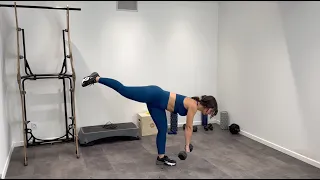
Single leg dumbbell romanian deadlift
Intermediate
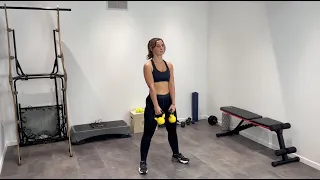
Kettlebell deadlift
Beginner
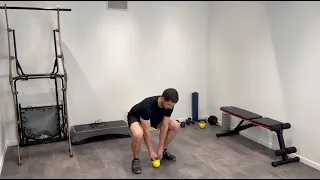
Kettlebell deadlift
Beginner
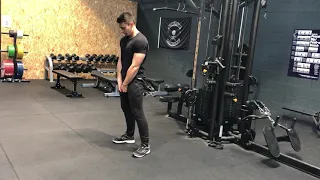
Cable pull-through
Beginner
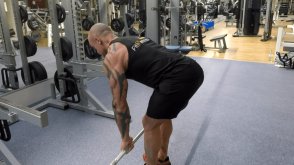
Straight leg deadlift
Intermediate
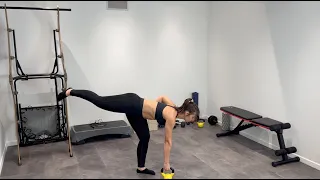
Kettlebell single leg deadlift
Intermediate
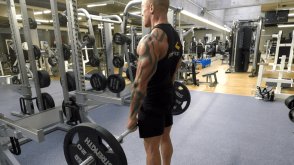
Barbell deadlift
Intermediate
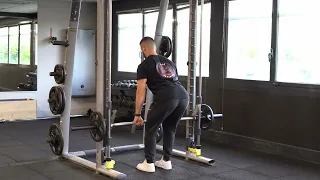
Smith machine deadlift
Intermediate
Related programs
See all
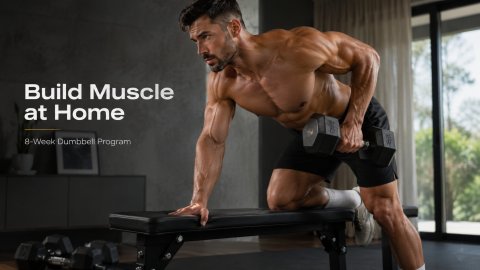
Related fitness articles
See all
Body recomposition: lose fat while building muscle
Muscle gain

Fitness formulas: protein, water, creatine and caffeine
Muscle gain

Carb cycling: useful for losing weight and performing better?
Nutrition

Muscle failure in strength training: what the science says
Muscle gain

Peptides in bodybuilding: effectiveness and risks
Nutrition
Chest pump push-up workout
Muscle gain
Succeeding at your first pull-up
At the gym

Shoulder pain in weight training: prevention and solutions
Risk of injuries
Recommended by our experts
Receive your personalized program
Stop training at random.
Get my program- Program tailored to your profile
- Guided progression
- Compatible with your equipment
- Structured plan
Our coach prepares your program
Get my program