Cuban Rotations
Demonstration video
Recommended by our experts
Receive your personalized program
Stop training at random.
Get my program- Program tailored to your profile
- Guided progression
- Compatible with your equipment
- Structured plan
Our coach prepares your program
Get my programHow to do Cuban Rotations
Instructions
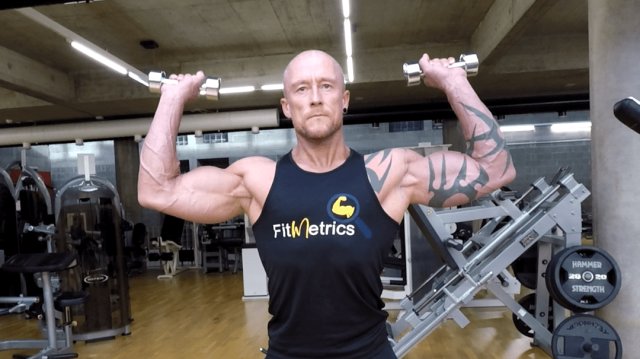
- Stand upright with a dumbbell in each hand and raise your upper arms to shoulder height, elbows bent at 90 degrees.
- Rotate your forearms upward while keeping your elbows fixed in place, reaching as far back as shoulder mobility allows.
- Pause briefly at the top, maintaining control and posture.
- Slowly lower your forearms back to the starting position in a controlled motion.
Technical Tips
- Keep elbows in line with shoulders at all times.
- Avoid arching your lower back by engaging your core.
- Use light weights to prioritize shoulder integrity and control.
- Do not rush the motion—control and range of motion are key.
Breathing Tips
- Inhale as you prepare at the starting position.
- Exhale slowly while rotating your arms upward.
- Inhale again as you return to the starting position.
Medical restrictions
- Rotator cuff injuries
- Shoulder impingement syndrome
- Recent shoulder surgery
- Severe shoulder mobility restrictions
Description
Cuban Rotations are a controlled shoulder mobility and stability exercise designed to strengthen the rotator cuff and posterior deltoids. Commonly used as part of warm-up routines or injury prevention programs, this movement targets the small but critical stabilizing muscles of the shoulder joint. By promoting external rotation and reinforcing scapular control, Cuban Rotations play an essential role in maintaining healthy shoulder mechanics, particularly for individuals engaged in overhead or throwing sports. Executed with light dumbbells and strict form, the exercise helps improve joint alignment and reduce the risk of shoulder impingement or dysfunction. Ideal for athletes, bodybuilders, or rehabilitation contexts, this exercise fosters muscle balance and joint integrity without placing excessive load on the shoulder capsule.
Credits

Frequently asked questions
-
What muscles do Cuban Rotations work?
Cuban Rotations primarily work the shoulders, especially the rotator cuff and rear deltoids, while also engaging the scapular stabilizers like the rhomboids. -
Are Cuban Rotations good for shoulder rehab?
Yes, Cuban Rotations are commonly recommended in shoulder rehabilitation programs because they improve rotator cuff strength and enhance joint stability with minimal load. -
How heavy should the dumbbells be for Cuban Rotations?
Use light dumbbells, typically between 1 to 5 kg, to maintain control and avoid straining the shoulder during the rotation movement. -
Can I do Cuban Rotations every day?
Yes, Cuban Rotations can be performed daily as part of a warm-up or mobility routine, especially if you're using light resistance and focusing on technique. -
Should I include Cuban Rotations in my warm-up?
Absolutely. Cuban Rotations are excellent for activating shoulder stabilizers and preparing your joints for heavier upper-body exercises like presses or pull-ups.
Variants and alternatives
See all
Related fitness articles
See all
Body recomposition: lose fat while building muscle
Muscle gain

Fitness formulas: protein, water, creatine and caffeine
Muscle gain

Carb cycling: useful for losing weight and performing better?
Nutrition

Muscle failure in strength training: what the science says
Muscle gain

Peptides in bodybuilding: effectiveness and risks
Nutrition
Chest pump push-up workout
Muscle gain
Succeeding at your first pull-up
At the gym

Shoulder pain in weight training: prevention and solutions
Risk of injuries
Recommended by our experts
Receive your personalized program
Stop training at random.
Get my program- Program tailored to your profile
- Guided progression
- Compatible with your equipment
- Structured plan
Our coach prepares your program
Get my program