Glute Ham Raise
Demonstration video

Recommended by our experts
Receive your personalized program
Stop training at random.
Get my program- Program tailored to your profile
- Guided progression
- Compatible with your equipment
- Structured plan
Our coach prepares your program
Get my programHow to do Glute Ham Raise
Instructions
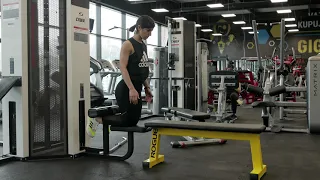
- Adjust the GHD so your knees are on the pad and feet are secured.
- Start in an upright position with your torso aligned and hands crossed on chest or at sides.
- Slowly lower your torso forward, keeping your back straight.
- Control the descent until your body is almost parallel to the floor.
- Engage your hamstrings and glutes to pull your body back to the starting position.
Technical tips
- Keep your core tight to avoid arching the lower back.
- Move slowly and with control during both lowering and raising phases.
- Do not let your hips sag; maintain alignment throughout the movement.
Breathing tips
- Inhale as you lower your body.
- Exhale as you contract your hamstrings and glutes to return upright.
Medical restrictions
- Lower back injuries
- Hamstring strains
- Knee instability or recent knee surgery
Description
The Glute Ham Raise is a highly effective lower body exercise that primarily strengthens the hamstrings and glutes while also engaging the lower back and core for stability. Performed on a Glute Ham Developer (GHD), this movement mimics the natural biomechanics of hip extension and knee flexion, making it one of the most functional posterior chain exercises available. Unlike traditional hamstring curls performed on machines, the Glute Ham Raise trains the muscles in a more complete range of motion, enhancing both strength and durability.
This exercise is widely used in strength and conditioning programs for athletes because it helps reduce the risk of hamstring injuries by improving eccentric strength. It is also popular among powerlifters, sprinters, and CrossFit athletes due to its direct carryover to explosive movements such as sprinting, jumping, and heavy lifting. In addition to performance benefits, the Glute Ham Raise also contributes to better posture by reinforcing spinal alignment and building the muscles that support the pelvis.
While the movement is challenging, its benefits extend beyond athletic performance. It improves functional strength, balance between the quadriceps and hamstrings, and overall lower body power. For those seeking to build resilient hamstrings and stronger glutes, the Glute Ham Raise is considered one of the most advanced and rewarding bodyweight resistance exercises.
Frequently asked questions
-
What are the benefits of doing the Glute Ham Raise?
The Glute Ham Raise strengthens the hamstrings, glutes, and lower back, improves athletic performance, reduces injury risk, and builds functional posterior chain strength. -
What is the most common mistake in the Glute Ham Raise?
The most common mistake is arching the lower back or letting the hips sag instead of keeping the torso aligned, which reduces effectiveness and increases injury risk. -
Is the Glute Ham Raise safe for my knees and lower back?
Yes, when performed with proper form it is safe, but individuals with existing knee or lower back injuries should avoid it or consult a professional before starting. -
How does the Glute Ham Raise compare to the Nordic Hamstring Curl?
Both target the hamstrings, but the Glute Ham Raise allows for hip extension and knee flexion, providing a fuller range of motion, while the Nordic Hamstring Curl emphasizes eccentric strength. -
How many reps of Glute Ham Raises should I do?
Start with 3 sets of 5 to 8 controlled reps, focusing on quality over quantity, and gradually increase as strength and endurance improve.

Related fitness articles
See all
Body recomposition: lose fat while building muscle
Muscle gain

Fitness formulas: protein, water, creatine and caffeine
Muscle gain

Carb cycling: useful for losing weight and performing better?
Nutrition

Muscle failure in strength training: what the science says
Muscle gain

Peptides in bodybuilding: effectiveness and risks
Nutrition
Chest pump push-up workout
Muscle gain
Succeeding at your first pull-up
At the gym

Shoulder pain in weight training: prevention and solutions
Risk of injuries
Recommended by our experts
Receive your personalized program
Stop training at random.
Get my program- Program tailored to your profile
- Guided progression
- Compatible with your equipment
- Structured plan
Our coach prepares your program
Get my program