Dumbbell Split Squat
Demonstration video

Recommended by our experts
Receive your personalized program
Stop training at random.
Get my program- Program tailored to your profile
- Guided progression
- Compatible with your equipment
- Structured plan
Our coach prepares your program
Get my programHow to do Dumbbell Split Squat
Instructions
- Stand in a split stance holding a dumbbell in each hand at your sides.
- Keep your torso tall and your feet planted firmly on the floor.
- Lower your body by bending both knees until your back knee moves toward the ground.
- Pause briefly at the bottom while keeping your front heel down.
- Push through your front foot to return to the starting position.
- Complete all reps on one side, then switch legs.
Technical tips
- Keep most of the load on the front leg during each rep.
- Track your front knee in line with your toes.
- Maintain a neutral spine and avoid leaning forward excessively.
- Use a stride length that lets both knees bend comfortably.
- Move under control and avoid bouncing at the bottom.
Breathing tips
- Inhale before lowering into the squat.
- Brace your core as you descend.
- Exhale as you drive up to the starting position.
- Reset your breath and posture before the next rep.
Medical restrictions
- Recent knee injury or unresolved knee pain
- Hip injury that limits split-stance loading
- Acute ankle instability or painful ankle mobility restriction
- Lower back pain aggravated by standing loaded exercises
- Balance disorders that make unilateral training unsafe
Description
The dumbbell split squat is a highly effective unilateral lower-body exercise used to build strength, improve coordination, and develop better movement control. Unlike bilateral leg work, this exercise challenges each side independently, making it useful for addressing strength imbalances and improving side-to-side stability. Because the stance remains fixed, it is often easier to learn than a walking lunge while still delivering a serious training effect.
This movement is popular in bodybuilding, fitness, and athletic performance programs because it combines strength development with balance and posture control. Holding dumbbells at your sides creates a simple and practical loading option that works well for progressive overload. It also allows lifters to train hard without needing a barbell setup, making the dumbbell split squat accessible in most gym environments.
Another major benefit of the dumbbell split squat is its carryover to real-world and sport-specific movement. Training one leg at a time can improve single-leg control, deceleration, and lower-body endurance, all of which matter for running, jumping, changing direction, and everyday tasks such as climbing stairs. It also encourages better body awareness and helps many people clean up asymmetries that can be hidden during two-leg exercises.
For lifters looking to add variety to leg day, improve unilateral strength, and build a strong foundation for more advanced lower-body training, the dumbbell split squat is a reliable and versatile choice.
Frequently asked questions
-
What are the benefits of doing dumbbell split squats?
Dumbbell split squats help build unilateral leg strength, improve balance, enhance coordination, and reduce side-to-side strength imbalances. They are also excellent for improving lower-body control and making leg training more functional. -
What muscles does the dumbbell split squat target?
The dumbbell split squat mainly targets the quadriceps and glutes, while the hamstrings, adductors, core, and hip stabilizers assist throughout the movement. This makes it a strong compound lower-body exercise. -
What is the most common mistake in the dumbbell split squat?
The most common mistake is letting the front knee collapse inward or shifting too much weight into the back leg. A stable front foot, controlled descent, and proper knee tracking usually fix the issue. -
Is the dumbbell split squat safe for my knees?
Yes, for many people it can be knee-friendly when performed with good alignment, a controlled range of motion, and an appropriate load. Pain, instability, or poor tracking are signs to reduce load, shorten range, or get technique checked. -
How is a dumbbell split squat different from a Bulgarian split squat?
A dumbbell split squat keeps the back foot on the floor, which usually makes it easier to balance and learn. A Bulgarian split squat elevates the rear foot, increasing the stability challenge and often the range of motion demand. -
How many sets and reps should I do for dumbbell split squats?
A common starting point is 3 to 4 sets of 6 to 12 reps per leg, depending on your goal. Use lower reps for strength, moderate reps for muscle growth, and lighter higher-rep sets for control and endurance.
Variants and alternatives
See all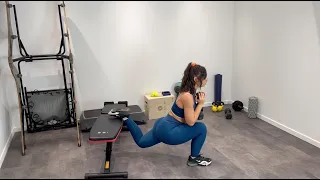
Dumbbell goblet bulgarian split squat
Intermediate
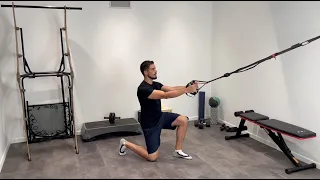
Trx split squat
Intermediate
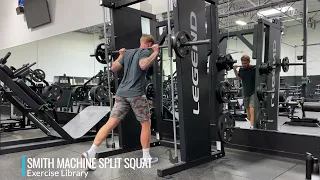
Smith machine split squat
Intermediate
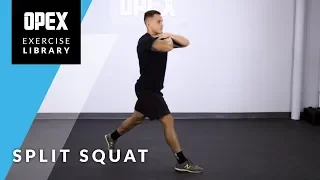
Bodyweight split squat
Intermediate
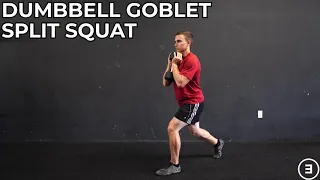
Dumbbell goblet split squat
Intermediate
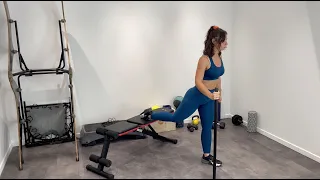
Assisted bulgarian split squat
Beginner
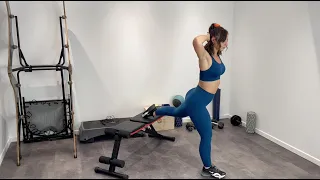
Cobra bulgarian split squat
Intermediate
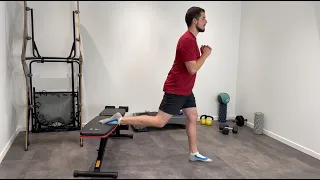
Bulgarian split squat
Intermediate
Related programs
See all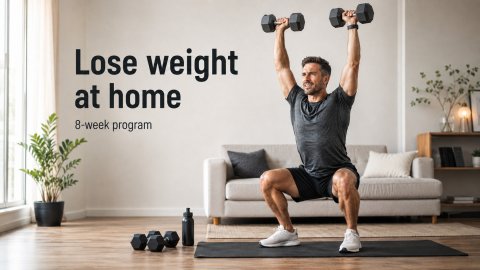
Related fitness articles
See all
Body recomposition: lose fat while building muscle
Muscle gain

Fitness formulas: protein, water, creatine and caffeine
Muscle gain

Carb cycling: useful for losing weight and performing better?
Nutrition

Muscle failure in strength training: what the science says
Muscle gain

Peptides in bodybuilding: effectiveness and risks
Nutrition
Chest pump push-up workout
Muscle gain
Succeeding at your first pull-up
At the gym

Shoulder pain in weight training: prevention and solutions
Risk of injuries
Recommended by our experts
Receive your personalized program
Stop training at random.
Get my program- Program tailored to your profile
- Guided progression
- Compatible with your equipment
- Structured plan
Our coach prepares your program
Get my program