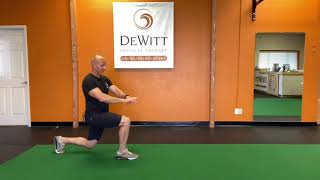
Walking Lunge with Trunk Rotation
Demonstration video
Recommended by our experts
Receive your personalized program
Stop training at random.
Get my program- Program tailored to your profile
- Guided progression
- Compatible with your equipment
- Structured plan
Our coach prepares your program
Get my programHow to do Walking Lunge with Trunk Rotation
Instructions
- Stand tall with your feet hip-width apart and extend your arms in front of your chest.
- Step forward with one foot and lower your body into a controlled lunge.
- Keep your pelvis facing forward and rotate your trunk toward the front leg.
- Return your trunk to the center and push through the front foot to rise.
- Step the rear leg forward and repeat the movement on the opposite side.
Technical tips
- Keep the front knee aligned with the second and third toes.
- Rotate through the upper trunk without twisting the front knee.
- Keep your torso tall and your pelvis stable throughout the movement.
- Use a stride length that allows both feet to remain firmly planted.
- Move slowly enough to maintain balance during each transition.
Breathing tips
- Inhale as you step forward and lower into the lunge.
- Exhale as you rotate toward the front leg.
- Inhale as you return your trunk to the center.
- Exhale as you push up and transition into the next step.
Medical restrictions
- Acute knee, hip, or ankle injury aggravated by lunging
- Acute lower-back pain or disc symptoms aggravated by rotation
- Severe balance impairment, vertigo, or uncontrolled dizziness
- Recent lower-limb or spinal surgery without medical clearance
Description
The walking lunge with trunk rotation is a dynamic, multi-planar exercise that combines forward locomotion with controlled upper-body rotation. It challenges the body to coordinate stepping, lowering, turning, and rising as one continuous movement, making it valuable for developing efficient whole-body movement patterns.
Unlike a standard walking lunge, the rotational component introduces an additional transverse-plane demand. This can improve the body's ability to transfer force between the lower and upper body during running, throwing, swinging, and directional changes. Regular practice can also enhance dynamic balance, spatial awareness, single-leg control, coordination, and stability during movement.
Because each repetition alternates sides, the exercise can help identify differences in control or confidence between the right and left sides. It develops familiarity with split-stance positions while encouraging smoother transitions from one step to the next. These qualities can support better movement efficiency in both athletic activities and everyday tasks.
The walking lunge with trunk rotation is particularly useful for preparing the body for activities involving multiple planes of motion. Its combination of locomotion and rotation creates a practical bridge between isolated movement preparation and more demanding physical activity. When performed consistently, it can contribute to improved movement quality, rotational control, balance, and transferable full-body coordination.
Frequently asked questions
-
What are the benefits of doing walking lunges with trunk rotation?
Walking lunges with trunk rotation improve dynamic balance, coordination, lower-body strength, rotational control, and the ability to transfer force between the upper and lower body. -
What is the most common mistake in a walking lunge with trunk rotation?
The most common mistake is allowing the front knee to collapse inward or turning the pelvis and knee instead of rotating through the trunk. -
Is the walking lunge with trunk rotation safe for my knees and back?
It is generally safe when performed with controlled range and pain-free technique. Shorten the stride or reduce the rotation if needed, and stop if you experience sharp pain, instability, or dizziness. -
Which direction should I rotate during the walking lunge?
Rotate your trunk toward the front leg while keeping your pelvis facing forward. Return to the center before stepping into the next repetition. -
How many walking lunges with trunk rotation should I do?
Begin with 6 to 10 repetitions per side or 12 to 20 alternating steps. One or two controlled sets are usually sufficient for movement preparation.
Variants and alternatives
See all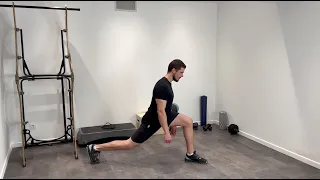
Long split pulse
Beginner

Single kettlebell reverse lunge
Intermediate
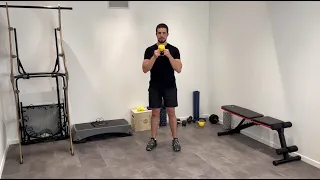
Kettlebell goblet curtsy lunge
Intermediate
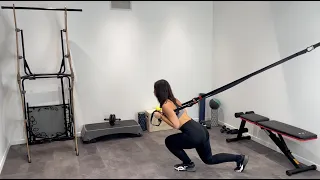
Trx sprinter start
Intermediate
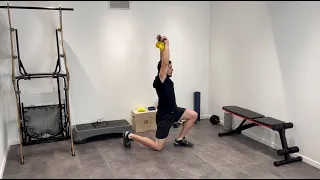
Kettlebell overhead lunge
Advanced
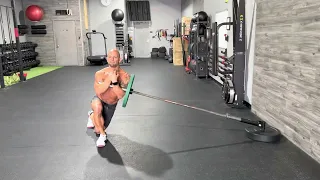
Landmine curtsy lunge to knee drive
Intermediate
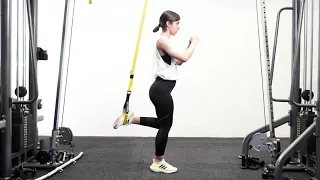
Trx lunge
Intermediate
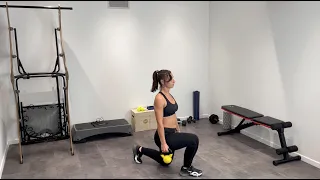
Kettlebell forward lunge
Intermediate
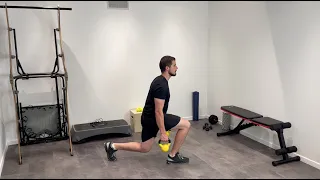
Kettlebell jumping lunge
Advanced
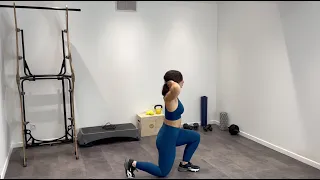
Cobra walking lunge
Intermediate
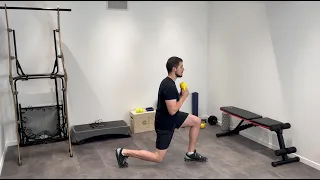
Kettlebell goblet pulse lunge
Intermediate
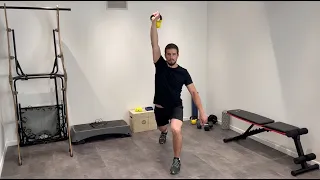
Kettlebell single arm jerk lunge
Advanced
Related fitness articles
See all
Body recomposition: lose fat while building muscle
Muscle gain

Fitness formulas: protein, water, creatine and caffeine
Muscle gain

Carb cycling: useful for losing weight and performing better?
Nutrition

Muscle failure in strength training: what the science says
Muscle gain

Peptides in bodybuilding: effectiveness and risks
Nutrition
Chest pump push-up workout
Muscle gain

Succeeding at your first pull-up
At the gym

Shoulder pain in weight training: prevention and solutions
Risk of injuries
Recommended by our experts
Receive your personalized program
Stop training at random.
Get my program- Program tailored to your profile
- Guided progression
- Compatible with your equipment
- Structured plan
Our coach prepares your program
Get my program