Dumbbell Lateral Lunge
Demonstration video

Recommended by our experts
Receive your personalized program
Stop training at random.
Get my program- Program tailored to your profile
- Guided progression
- Compatible with your equipment
- Structured plan
Our coach prepares your program
Get my programHow to do Dumbbell Lateral Lunge
Instructions
- Stand upright with your feet about hip-width apart and hold a dumbbell in each hand at your sides.
- Brace your core and take a controlled step laterally with one foot.
- Shift your hips back and bend the knee of the stepping leg while keeping the opposite leg extended.
- Lower until you reach a comfortable depth while keeping the working foot flat on the floor.
- Push through the working foot to extend your hip and knee and return to the starting position.
- Complete the prescribed repetitions on one side before switching sides, or alternate sides as programmed.
Technical tips
- Keep the knee of the working leg tracking in the same direction as your toes.
- Sit your hips back rather than allowing the knee to drive excessively forward.
- Keep your chest lifted and spine neutral throughout the movement.
- Maintain the entire working foot in contact with the floor.
- Use a lateral step wide enough to create space for your hips to descend without losing balance.
Breathing tips
- Inhale and brace your trunk as you step laterally and lower into the lunge.
- Maintain abdominal tension at the bottom of the movement.
- Exhale as you push through the working leg and return to standing.
Medical restrictions
- Acute groin or adductor strain
- Painful knee injury or significant knee instability
- Acute hip or ankle injury that limits lateral movement
- Severe balance impairment unless appropriately supervised
Description
The dumbbell lateral lunge is a unilateral lower-body strength exercise that develops strength and control in the frontal plane. The lateral stepping pattern challenges the hips and legs through a different direction of movement than traditional forward or reverse lunges, making it useful for improving side-to-side strength, hip control and overall lower-body athletic capacity.
Frequently asked questions
-
What are the benefits of doing dumbbell lateral lunges?
Dumbbell lateral lunges build lower-body strength while developing side-to-side hip control and frontal-plane movement capacity. They are particularly useful for strengthening the legs through lateral movement patterns that are less emphasized by traditional squats and forward lunges. -
What is the most common mistake when doing a dumbbell lateral lunge?
A common mistake is allowing the working knee to collapse inward while the foot rolls onto its inside edge. Keep the entire foot planted, track the knee with the toes and push the hips backward as you descend. -
Are dumbbell lateral lunges safe for my knees?
They are generally safe when performed with an appropriate load, controlled range of motion and proper knee alignment. Reduce the depth or load if you cannot keep the knee tracking comfortably over the foot, and stop if the movement causes joint pain. -
What is the advantage of a dumbbell lateral lunge compared with a bodyweight lateral lunge?
Adding dumbbells increases external resistance, making progressive strength and muscle development easier. The bodyweight version is usually better for learning the movement pattern first, while the dumbbell version provides a greater loading stimulus once technique is stable.
Variants and alternatives
See all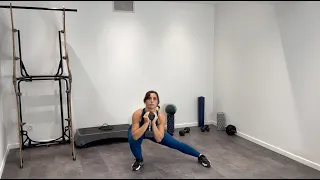
Dumbbell goblet lateral lunge
Intermediate
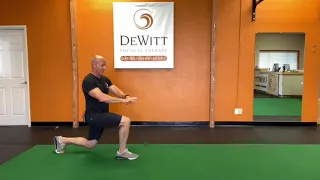
Walking lunge with trunk rotation
Intermediate
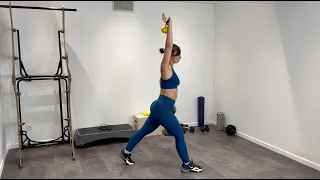
Kettlebell single arm standing overhead lunge
Advanced
Smith machine lunge
Intermediate
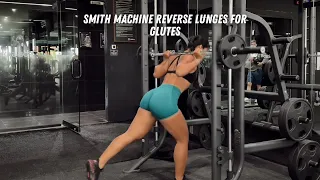
Smith machine reverse lunge
Intermediate
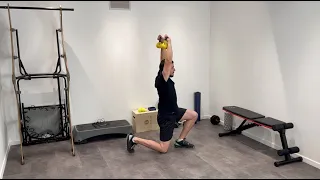
Kettlebell overhead lunge
Advanced
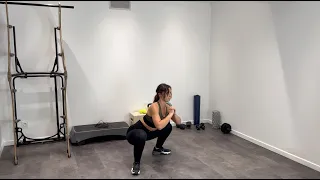
Clock lunge
Intermediate
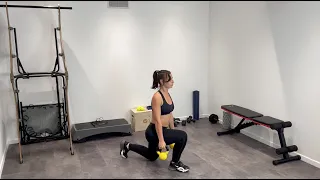
Kettlebell reverse lunge
Intermediate
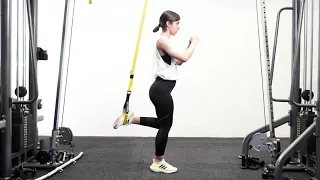
Trx lunge
Intermediate
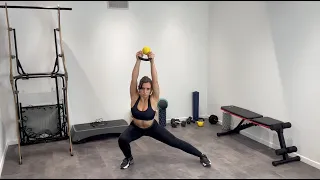
Kettlebell overhead lateral lunge
Intermediate
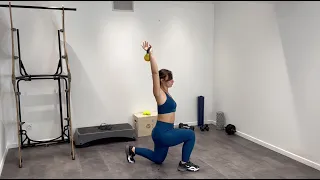
Kettlebell overhead lunge
Advanced
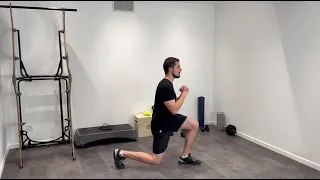
Pulse lunge
Intermediate
Related programs
See all
Related fitness articles
See all
Body recomposition: lose fat while building muscle
Muscle gain

Fitness formulas: protein, water, creatine and caffeine
Muscle gain

Carb cycling: useful for losing weight and performing better?
Nutrition

Muscle failure in strength training: what the science says
Muscle gain

Peptides in bodybuilding: effectiveness and risks
Nutrition
Chest pump push-up workout
Muscle gain
Succeeding at your first pull-up
At the gym

Shoulder pain in weight training: prevention and solutions
Risk of injuries
Recommended by our experts
Receive your personalized program
Stop training at random.
Get my program- Program tailored to your profile
- Guided progression
- Compatible with your equipment
- Structured plan
Our coach prepares your program
Get my program