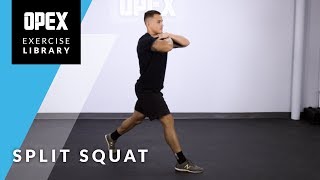
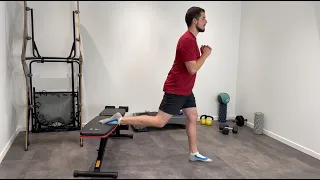
Bodyweight Split Squat
Demonstration video
Recommended by our experts
Receive your personalized program
Stop training at random.
Get my program- Program tailored to your profile
- Guided progression
- Compatible with your equipment
- Structured plan
Our coach prepares your program
Get my programHow to do Bodyweight Split Squat
Instructions
- Stand in a staggered stance with one foot forward and the other behind you.
- Keep the front foot flat and the heel of the rear foot raised.
- Brace your core and keep your torso tall.
- Bend both knees and lower your body vertically toward the floor.
- Descend until the rear knee approaches the floor or as far as you can comfortably control.
- Push through the front foot to return to the starting position.
- Complete the prescribed repetitions, then switch sides.
Technical tips
- Keep most of your working pressure through the front foot.
- Keep the front knee tracking in line with the toes rather than collapsing inward.
- Use a stance long enough to allow both knees to bend comfortably.
- Lower your body mostly straight down instead of shifting excessively forward.
- Maintain controlled movement and avoid bouncing at the bottom.
- Keep your hips facing forward throughout the repetition.
Breathing tips
- Inhale as you lower into the split squat.
- Maintain abdominal tension near the bottom position.
- Exhale as you push through the front leg to stand back up.
Medical restrictions
- Avoid or modify the exercise if you have acute knee, hip, ankle, or lower-back pain.
- Use caution if a recent lower-limb injury limits weight-bearing, balance, or joint range of motion.
- Seek medical or rehabilitation guidance before performing the exercise after recent lower-body surgery.
Description
The Bodyweight Split Squat is a unilateral lower-body strength exercise that develops the quadriceps and glutes while challenging hip stability, coordination, and balance. Because the feet remain in a fixed staggered position, it allows controlled single-leg-focused training without equipment and can help reduce strength differences between the left and right sides.
Frequently asked questions
-
What are the benefits of doing Bodyweight Split Squats?
Bodyweight Split Squats strengthen the quadriceps and glutes, improve unilateral leg strength, challenge balance and hip stability, and can help address strength differences between sides without requiring equipment. -
What is the most common mistake I should avoid in a Bodyweight Split Squat?
A common mistake is using a stance that is too short, which can make the movement unstable and increase forward knee and torso movement. Use a comfortable staggered stance, keep the front foot flat, and lower your body under control. -
Are Bodyweight Split Squats safe for my knees?
Bodyweight Split Squats are generally safe for healthy knees when performed with controlled technique. Keep the knee aligned with the toes, use a comfortable range of motion, and reduce depth or stop if you experience sharp or persistent pain. -
Which muscles do I work with Bodyweight Split Squats?
Bodyweight Split Squats primarily work the quadriceps and glutes. The hamstrings, adductors, calves, gluteus medius, and other stabilizing muscles also contribute to controlling the hips, knees, and ankles. -
How is a Bodyweight Split Squat different from a lunge?
In a Bodyweight Split Squat, both feet stay in a fixed staggered position while you move up and down. In a traditional forward or reverse lunge, you step into or out of the position during each repetition, which adds more dynamic balance and coordination. -
How many Bodyweight Split Squats should I do?
For general strength and muscle endurance, 2 to 4 sets of 8 to 20 controlled repetitions per leg is a practical range. Increase repetitions, range of motion, tempo, or exercise difficulty as the movement becomes easier.
Variants and alternatives
See all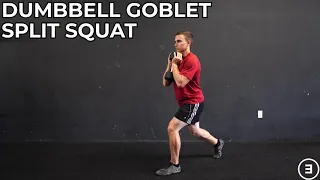
Dumbbell goblet split squat
Intermediate
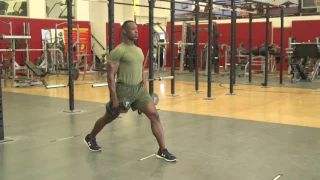
Dumbbell split squat
Intermediate
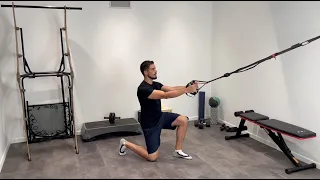
Trx split squat
Intermediate
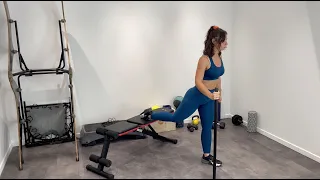
Assisted bulgarian split squat
Beginner
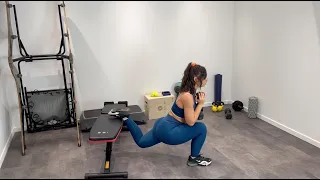
Dumbbell goblet bulgarian split squat
Intermediate
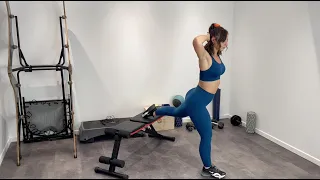
Cobra bulgarian split squat
Intermediate
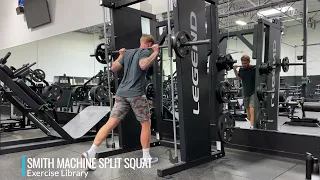
Smith machine split squat
Intermediate
Bulgarian split squat
Intermediate
Related programs
See all
Related fitness articles
See all
Body recomposition: lose fat while building muscle
Muscle gain

Fitness formulas: protein, water, creatine and caffeine
Muscle gain

Carb cycling: useful for losing weight and performing better?
Nutrition

Muscle failure in strength training: what the science says
Muscle gain

Peptides in bodybuilding: effectiveness and risks
Nutrition
Chest pump push-up workout
Muscle gain
Succeeding at your first pull-up
At the gym

Shoulder pain in weight training: prevention and solutions
Risk of injuries
Recommended by our experts
Receive your personalized program
Stop training at random.
Get my program- Program tailored to your profile
- Guided progression
- Compatible with your equipment
- Structured plan
Our coach prepares your program
Get my program