Self-Resisted Hammer Curl
Demonstration video

Recommended by our experts
Receive your personalized program
Stop training at random.
Get my program- Program tailored to your profile
- Guided progression
- Compatible with your equipment
- Structured plan
Our coach prepares your program
Get my programHow to do Self-Resisted Hammer Curl
Instructions
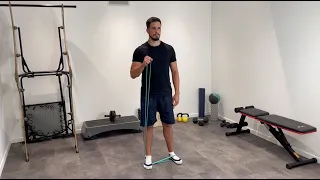
- Stand or sit tall with the working elbow close to your side.
- Make a fist with the working hand and keep the thumb pointing upward.
- Place the opposite hand over the working wrist or lower forearm.
- Curl the working forearm upward while the opposite hand presses down to create resistance.
- Pause briefly near the top without letting the elbow move forward.
- Lower the working arm slowly while maintaining resistance with the opposite hand.
- Complete the repetitions, then switch arms.
Technical tips
- Keep the working wrist straight and apply pressure to the lower forearm, not the fingers.
- Use smooth, steady resistance through the full range of motion.
- Keep the upper arm still and avoid leaning or twisting the torso.
- Match the resistance to a level that allows controlled movement without joint pain.
Breathing tips
- Exhale as you curl the working arm upward.
- Inhale as you lower the arm under control.
- Avoid holding your breath while creating resistance.
Medical restrictions
- Avoid this exercise with an acute elbow, wrist, or forearm injury.
- Do not perform it during recovery from a distal biceps tendon tear or recent arm surgery unless cleared by a clinician.
- Stop if you feel sharp pain, numbness, tingling, or increasing joint discomfort.
Description
The self-resisted hammer curl is a controlled upper-arm strengthening exercise in which one hand creates resistance against the other. Its main purpose is to develop elbow-flexion strength with a neutral hand position while allowing the trainee to regulate effort instantly. Because the resistance is self-generated, the exercise can be made very light for rehearsal or progressively harder for demanding sets simply by increasing the pressure from the opposing hand.
A key benefit is continuous, adjustable tension. Unlike a fixed external load, self-resistance can be modified at every point in the repetition, helping maintain a smooth challenge through ranges that may otherwise feel easier. This makes the movement useful for improving muscular control, concentration, and the ability to produce force deliberately rather than relying on momentum. It also encourages both arms to work together: one arm performs the curl while the other supplies and regulates the opposing force.
The exercise is practical for short strength sessions, travel workouts, movement preparation, or situations where conventional loading is unavailable. It can also serve as a bridge before progressing to externally loaded hammer curls because the trainee can learn the movement pattern and effort level with immediate feedback. When performed with consistent tension and deliberate pacing, the self-resisted hammer curl offers an efficient way to build strength endurance, reinforce controlled repetitions, and add targeted arm work to a broader training program. Its simplicity also makes it easy to scale across different fitness levels without changing the basic exercise.
Frequently asked questions
-
What benefits can I get from self-resisted hammer curls?
Self-resisted hammer curls provide adjustable tension, improve arm strength endurance, reinforce controlled elbow flexion, and require no external load. They also help you maintain steady effort throughout each repetition. -
What is the most common mistake when I do a self-resisted hammer curl?
The most common mistake is bending the wrist or moving the elbow forward. Keep the wrist neutral, the elbow close to your side, and the resistance smooth instead of applying sudden force. -
Is the self-resisted hammer curl safe for my elbows and wrists?
It is generally safe when the resistance is moderate, the wrist stays straight, and the movement is pain-free. Reduce the pressure or stop if you feel sharp joint pain, tingling, or discomfort that increases during the set. -
Should I choose a self-resisted hammer curl or a dumbbell hammer curl?
Choose the self-resisted version when you need instantly adjustable resistance without a weight. Dumbbell hammer curls are better when you want to measure the load precisely and apply more objective progressive overload. -
How many self-resisted hammer curl reps should I do?
Start with 2 to 3 sets of 8 to 15 controlled repetitions per arm. Make each repetition challenging by maintaining steady resistance, but stop before your form or wrist position breaks down.
Variants and alternatives
See all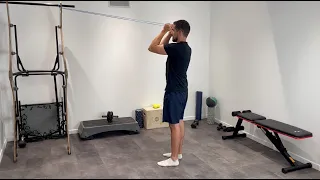
Related programs
See all
Related fitness articles
See all
Body recomposition: lose fat while building muscle
Muscle gain

Fitness formulas: protein, water, creatine and caffeine
Muscle gain

Carb cycling: useful for losing weight and performing better?
Nutrition

Muscle failure in strength training: what the science says
Muscle gain

Peptides in bodybuilding: effectiveness and risks
Nutrition
Chest pump push-up workout
Muscle gain
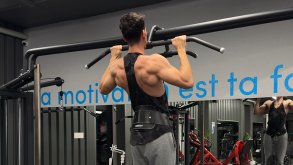
Succeeding at your first pull-up
At the gym

Shoulder pain in weight training: prevention and solutions
Risk of injuries
Recommended by our experts
Receive your personalized program
Stop training at random.
Get my program- Program tailored to your profile
- Guided progression
- Compatible with your equipment
- Structured plan
Our coach prepares your program
Get my program